Showing posts with label scattershot. Show all posts

5/15/2014

BlogHop: Three Things I Don’t Write (& Three Things I Do)

Another one of these author blog hops thingies, this time on the theme of three things I don't write about, and three I do. I was nominated by the always ace sci-fi author Neil Williamson, who also nominated Chris Beckett and Keith Brooke (who's such a swot he's written his already). My own nominations are at the end of my piece. 
So without further ado...
Three Things I Don’t Write About:
  • Real Places: I set stories in real places where the story itself seems to demand it, but most of the time I don't feel the urge. A lot of my stories are set in unnamed urban settings; recognisably British maybe, but not somewhere you could actually recognise as being Nottingham or Basingstoke or Widnes or wherever. As long as the readers recognise the details of the place that I'm using for atmosphere - the lonely bus-stop or the graffiti ridden alleyway - then I don't think it needs to be a specific town or city. Indeed I think such detail in a short story, where everything needs to dovetail together, could be counter productive. As I said, there are exceptions in my work such as Home Time (very specifically about the contrast between Oxford and a Nottinghamshire mining village) but even here it's what the place means to the character and the story that's important, not accurately depicting it as is in real life.
  • ‘Monsters’ That Might As Well Be Real Animals: A lot of horror deals with death, and so obviously a lot of horror deals with things that kill people. But what bores me is to write the kind of horror where the ‘monster’ – be it vampire, psycho, or blob from the plant K – is just a physical threat which people either run from, fight, or get eaten by. As far as the plot goes, the monster might just as well be a wild dog. Which isn't to say physical beasts don’t feature in my work; it's just I like my monsters to mean something and for the characters to be fighting for more than their brute survival – for their sanity, perhaps, or their view of the world, or to preserve their illusions. I especially like to write about horrors that might not be physical at all – The Other Room being an example.
  • Cthulhu & Co: For a writer who portrayed cultist as mad degenerates, it’s ironic how much of a cult has built up around HP Lovecraft’s so-called mythos. I find it odd how Cthulhu and the like, vast and literally indescribable beings who induce awe and madness in equal measure, have been minimised by later generations into generic horror tropes, or t-shirt designs, cuddly toys or RPG monsters with their stats spelt out for you like a kobold’s. Some authors, obviously, have taken Lovecraft's ideas and twisted them to their own ends – TED Klein and Ramsey Campbell spring immediately to mind – and Neil Gaiman’s inspired spoof Shoggoth's Old Peculiar is brilliant. But in general I don’t understand the urge to write ‘straight’ Lovecraft homages nor do I have much interest in the plethora of anthologies called things like Cthulhu In The Wild West or Dagon In The West End. It seems doubly strange because it’s so obvious from reading his work that Lovecraft was using the imagery of his mythos to help articulate a highly philosophical and personal view of existence. He wasn't just thinking Ohhhh Godzilla with a squid for a head – cool!

 Three Things I Do Write About:
  • Doubles & Doppelgängers: I think anyone who’s read even a fraction of my work will probably have picked up on this. There’s the obvious doppelgänger stories like Falling Over or New Boy, where there’s a physical copy of someone (maybe)  but there’s also the Jekyll and Hyde like parallels within people’s personalities that I exploit in stories like The Other Room and The Time Of Their Lives. Coming at it all from a completely different angle is Dark Reflections (forthcoming from Knightwatch Press next year) which, as you can possibly guess from the title is about that doppelgänger we all have on the other side of the mirror… There’s also a second aspect to this, where two different stories serve as partial reflections of each other – for example in the collection Falling Over, the story The Time Of Their Lives tells of some sinister adult behaviour from the uncomprehending point of view of a child… whereas Sick Leave shows an adult protagonist struggling to grasp the equally incomprehensible behaviour of a group of eerie children… I didn't write these stories to be conscious reflections of each other (indeed, they were written years apart) but when putting together a collection of stories I like finding these kinds of echoes in my work and to exploit them where I can.
  •   Ambiguity: I love endings where you're still not sure what will happen next, or still not sure what has happened, and especially endings where you're not really sure what it all means. There's lots of different types of ambiguity in narrative, and I've argued before that if anything distinguishes 'weird fiction' from straight horror it's ambiguity. That's not to say that my stories simply just stop, or become so weird as to be impenetrable - trying to get the emotional kick of an ending whilst not tying everything up with a neat bow is what I'm going for. 
  •  Flawed People: God, is there anything more boring to write about than happy well-adjusted people? Or even worse, people with so many abilities and advantages that they overcome everything they face? This is something Neil included in his three things, actually, where he said he’d never write about superheroes and I completely see his point. Even where people in my stories do have abilities beyond the ordinary (Regina in The Watchers for example) their ‘powers’ are as much a curse as a blessing, and not really under their control. But I'm not much drawn to this theme, and much prefer to write about flawed, two-faced, self-deceiving and even downright repellent people in my fiction. Part of his goes back to the idea that the horrors of the story should have some connection to the protagonist, and part of it is the much simpler horror trope that an unpleasant protagonist should get their comeuppance in the end.
Passing The Baton...
Up next are Mark West, Amelia Mangan, and Jennifer Williams. Fabulous writers one and all, so do see what they have to say for themselves.

3/31/2013

England Made Me

So, the always-excellent Vivienne Tuffnell invited me to participate in another of these author-blog-questions-pass-it-on-thingys. And as it's Viv, who was lovely enough to publish my ramblings about Weird Fiction, I've taken part.

Q: where were your born and where do you live now?
I live in Nottingham, a few miles out from the city centre. I was born in a village called Cotgrave, which you can just see if you zoom in on the map. If you move your finger left from there, you're at the place where The Shelter is/was - unless it only exists in my head (see the Afterword in that book).

I also lived in Oxford for three years.

Q: Have you always lived and worked in Britain or are you based elsewhere?
Always in Britain. England made me, essentially, despite what I think about a lot of the people and politics and whatnot here. It might be lurching evermore right-wing, but the beer's still good.


Q: Have you highlighted or showcased any particular part of Britain in your books, a town, a city, a county, a monument, well-known place or event?
A lot of my stories take place in an unnamed and unspecified (although still obviously English) city. However there's a few where real places have formed the basis for them. Red Route is set on a very specific stretch of road in Lincolnshire - the red route signs showing the numbers of deaths are real. And Home Time is very much about the differences the character sees between living in a village in Nottinghamshire and living in the almost dream-like city of Oxford. 

Q: Tell us about one of your recent books...
I'm not sure any of them qualify as recent any more, so I'll just mention again that my next book, Falling Over, will be out in the summer from Infinity Plus.

Q: What are you currently working on?
I'm doing the formatting for a print-version of The Other Room as well as writing the first draft of a short story about someone alone in a lock-keeper's cottage. That character is sums up all I dislike about a certain kind of British (well, English) petty, immigrant-bashing nationalism, actually. The story's not finished yet, but he'll get his comeuppance, I think...

Q: How do you spend your leisure time?
This is like that last question on a job application that I never know how to answer... Reading, obviously - lots of reading. Listening to music. Cooking curries. Not doing as much swimming and exercise as I should. 

Q: Do you write for a local audience or a global audience?
Neither, I don't think. I reckon it's more a global niche audience - that's the great thing about the internet, you can reach the people who have similar cult tastes to you no matter where they are. That said, I guess the stories do contain various British references, slang-words, spellings etc. so readers need to be at least open to that. But my readers are cool, so that's never been a problem.

3/19/2013

Robert Aickman Word Clouds

So, I've been participating in a fabulous group read of The Wine Dark Sea by Robert Aickman - no need to explain to regular readers how much I admire Aickman's stories, I'm sure I've banged on about him often enough...

Anyway, I wanted to do a post about some of the stories in the book, and I've decided to do something a bit different. Because reading Aickman is so subjective I'd hesitate to offer my interpretation of one of his stories as definitive; so (with their permission) I've decided to use other people's words from the group read to create these 'word-clouds' for the title story and for The Trains. The phrases are just ones that struck me from the discussion, be they people's view on what the story meant, or other stories it reminded them of, or whatever. The idea was to get a more impersonal, multi-layered, ambiguous description of each story than if I'd just waffled on myself.

I think the results look quite good, and if there's a positive response I'll probably do a couple more.

The Wine Dark Sea

The Trains

2/15/2013

Eleven Facts, Eleven People, Eleven Questions

So, I've been nominated by Martin Cosby (a new weird fiction author who I suspect you might be hearing more of...) for one of these blog thingies; it's called a Leibster apparently, and I have to:

a) reveal eleven facts about myself
b) answer eleven questions from Martin
c) set eleven questions for eleven other people

So without further ado, eleven facts:
  1. Six days out of seven I will be wearing a Fred Perry polo shirt. 
  2. As I type this I am listening to the song Wonderful Excuse by The Family Cat. I also own a cat called George (or as much as anyone ‘owns’ a cat, at any rate). 
  3. I have never broken any bones. Well, not my own. 
  4. I suffer frequently from déjà-vu. 
  5. I once dressed as ‘boy from Kes’ for a film themed fancy dress party. This involved hasty manipulation of a rubber glove, some shoe-laces, and a kestrel I coloured in with felt-tips on some cardboard. 
  6. I run the Headington Shark Appreciation Society (new members welcome). 
  7. The first film I ever saw at the cinema was The Empire Strikes Back. It was a double-bill with the first film but my parents got the times wrong, so I saw them the wrong way round. I suspect this explains a lot. 
  8. My favourite cocktail is a Whisky Sour. 
  9. I am 89% sure that my life is not a Truman Show style hoax. 
  10. I contend that the best album of the 90s is Giant Steps by The Boo Radleys. 
  11. I suffer frequently from déjà-vu.


Martin's questions for me: 

1. Do you write your first drafts by hand?
Yes I do. Writing by hand has lots of pluses (more speed, less distractions) and few negatives. I know some people would view having to type it up the first draft as a negative, but for me that's a plus too: it means going over every single line of prose again at least once.

2. Do you follow more than 10 blogs?
Yes - see sidebar >>>>>>>>

3. Do you play a musical instrument?
No. I'd love to be able to play guitar but I tried a few times as a teen, and good Christ I was bad. And not even bad in a sounds-cool-feedbacky kind of way, but just bad.

4. Given the choice, which opera would you attend?
Ummm, I know nothing about opera. Nothing. What was that one Mark Twain compared to an orphanage burning down? I'll go for that one.

5. e-book or paper book?
Both. I don't care if it's against the rules - both!

6. Do you use an electric blanket?
No. I don't know how to expand on that answer to make it vaguely interesting, sorry.

7. Do you write in cafes?
No, but I'd like to. Life isn't that luxurious at the moment.

8. Is there a film that has influenced you greatly? 
The Empires Strikes Back - see above.

9. Do you keep a diary?
Not a personal one, but I do have a 'writing diary'. Like so much else in my life it is sporadic, partially illegible, and woefully behind schedule.

10. Which foodstuff do you like the least?
I had something in France - the name escapes me - I love most French food, including snails and the like, but this was vile. It stank to high heaven and ruined a perfectly good piece of fish beneath it. When we looked up the translation, it just said it was a dish consisting of 'innards stuffed with innards'.

11. Do you listen to music while you work? If so, what?
Yes, all the time unless I'm doing final editing of a story. Favourite artists include The Auteurs, Laura Marling, Bob Dylan, EMA, Pavement, Viva Voce, Radiohead...

And now, my eleven questions for eleven fine people:

Alan Ryker, Iain Rowan, Robert Dunbar, Cate Gardner, Dan Holloway, Colin Barnes, Victoria Hooper, Greg James, Anne Michaud, Luca Veste and Neil Schiller.

  1. Who’s the most underrated author out there that you know of? 
  2. You need to pick one song to be used to torture unpleasant terrorist types, by playing it to them full volume 24/7. What do you pick? 
  3. As a writer, what is your own personal definition of success? 
  4. How do you like your steak? 
  5. A genie grants you get an extra hour every day, meaning your days are 25 hours long. The condition is you must use this hour to take up a brand new hobby. What do you pick? 
  6. What’s the most overrated piece of writing advice you’ve ever been given? 
  7. If you were in a band, what would your band name be? 
  8. Oxford Commas – yes or no? 
  9. What’s the most embarrassing typo or mistake you’ve ever found in your work after publication? 
  10. Who’s your favourite Muppet? 
  11. Will you write me a haiku?

1/16/2013

Strange Story #20: House Of Leaves

Strange Story #20: House Of Leaves
Author: Mark Z. Danielewski

Make no mistake, those who write long books have nothing to say. Of course those who write short books have even less to say...


Most of the strange stories I've featured in this column to date have been short, controlled tales – paranoia and fear mounting to a single moment of horror. Whilst the best of these stories might imply a lot, they definitively state very little.

House Of Leaves is not that kind of story.

This is a huge novel (and one you must read in its physical version rather than as an ebook, as the photographs in this post will indicate) with multiple plots and sub-plots, typographical tricks, footnotes and diversions. It tells the story of ‘The Navidson Record’, a film by a renowned photographer about a very singular house.

The book takes the form of an academic treatment of the film, discussing its themes and veracity. This has apparently been written by Zampano, a blind man who dies in mysterious circumstances. His manuscript is recovered by a second character, Johnny Truant, who interprets the Zampano notes and The Navidson Record in his own way, as well as chronicling the breakdown he suffers whilst reading the material, despite the fact that he can find no evidence that the film even exists.


So the book is in effect one narrator annotating the notes of another narrator about a film neither can ever have seen (one doubting it is real, the other being blind) and that even if it does exist might just be a fake anyway. I think.

Added to this, the book is a labyrinth (and that word is chosen deliberately) of other stories, from Johnny’s tall-tales told to impress girls to historical accounts of people shipwrecked in the Arctic. The book also features seemingly never-ending lists (of architectural features, famous photographers, ghost stories etc.), mirror-writing, poems, and letters with a secret code. There are 'quotations' about the Navidson Record from people like Derrida, Camile Paglia, and Stephen King. There are a number of seemingly trivial mysteries that nevertheless prey on the mind: why is the word house (or any translation thereof) in a different colour & font to the rest of the text? Why is every reference to the Minotaur myth crossed through?

This book achieves ambiguity not through sparseness of detail but through a surfeit of it.

And there remains the fact that, despite the interruptions and longueurs, there is at the core of this book a truly frightening and original horror story. The Navidson Record starts with the Navidson family moving into a new house, and Navidson realising his house appears to be a fraction of an inch bigger on the inside than the outside: Lovecraft’s crazy geometry rewritten on a domestic scale. Soon after, a door appears in the house that wasn't there before, that appears to open onto a small, dusty corridor… which is clearly occupying the same physical space as the garden outside the house. Navidson, and later others, explore the corridor, and they soon realise the space behind the door is potentially huge (infinite?), and shifting and protean... and there might be something in that impossible space with them. The sheer impossibility of the house, initially represented by that small fraction of an inch, becomes something experienced on a far vaster scale. Added to this is the very human drama played out between Navidson and his wife Karen, who desperately wants her husband to stop exploring the house, and between Navidson and his estranged brother Tom. The book contains several moving moments of catharsis as well as it's brain-frying detail.


House Of Leaves seems to me a stunning achievement, a book that will become a true classic of the genre (despite the fact that no genre can really contain it). It meshes post-modernism with a strong knowledge of horror tropes, and comes up with something absolutely original. It contains enough intellectual stimulation to fuel a thousand post-graduate essays, but with enough twists and turns of the plot to turn it into an addictive page-turner too. Despite its size it’s compulsively readable, and re-readable – I've read it three times now and found new pleasures and confusions each time.

In fact, typing this, it occurs to me it's a love story, too.

Absolutely essential reading.

7/20/2012

When (Headington) Sharks Attack...


I still remember the first time I saw the Headington Shark - I was in my first year at Oxford Brookes university (for the uninitiated, an ex-poly and not part of the Oxford University) whose main campus is in Headington, where I lived in halls.

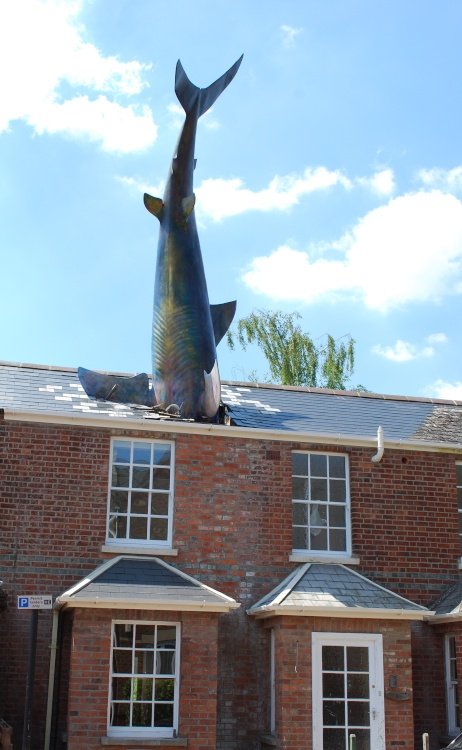
However they have a second campus at Wheatley and I had to get the university bus there for some lectures - the bus goes up London Road and I was vacantly staring out the window, somewhat hungover (okay, very hungover - this was Fresher's Week after all) and looking down the side streets as we passed. Down one of the streets I saw this:


To be honest I wasn't used to being so massively hungover (I am now) and it was one of the few times in my life I genuinely thought I might be hallucinating. Understand I only saw it for a second at most as the bus passed the top of the road.

All these years (and hangovers) later it's still one of my favourite things about Oxford, and recently I read The Hunting Of The Shark by Bill Heine, the chap whose house has the shark crashing into it. It's an interesting story, both about how the shark come about, and about the years-long battle with petty bureaucracy to keep it in place. It went almost all the way to the top of the Tory Government of the time, where bizarrely Michael Heseltine saved it, with these words (which remain the most sensible words I've heard from a Conservative MP): 
"...it is not in dispute that the shark is not in harmony with its surroundings, but then it is not intended to be in harmony with them. The basic facts are there for almost all to see. Into this archetypal urban setting crashes (almost literally) the shark. The contrast is deliberate... An incongruous object can become accepted as a landmark after a time, becoming well known, even well loved in the process..."
 “It is beautiful, it’s surprising, it’s funny, it’s poetic; it cheers me up whenever I go past it.” Phillip Pullman
And so it came to be. When I lived in Headington, giving directions was always done in relation to "the shark"; local shops and pubs sold postcards and key-rings of it, and some tourists even came to see it first rather than the dreaming spires... Despite all the dire predictions about house prices at the time, they actually went up a good few percent more on this street then others around, and local Estate Agents proudly mention  if a property is in view of the shark now...

I won't give the book a proper 'review' as let's face it, unless you've seen the shark in the flesh, you're unlikely to want to read it. But if you have and it's stuck with you as much as me, rest assured - it's everything you'd want a book about the shark to be.

(I created the Headington Shark Appreciation Society on Facebook, back when Facebook was cool, if anyone is interested.)

7/15/2012

Some Thoughts on Edge-Lit

Yesterday I went to Edge-Lit, a one-day convention of horror, science fiction and fantasy writing. I've never been to anything like this before, but this was just down the road (well, train tracks) in Derby, and I'd met the organiser Alex Davis at a writing course before, so I bought a ticket.

I went on my own and didn't know anyone there personally; I recognised a few name badges from Twitter and probably should have plucked up the courage to say hello. But I'm really not the type who can just walk up to strangers and introduce myself, despite the fact that I know from experience if I just forced myself people would probably have loved to say hello & shared a beer, just as I would have in their shoes. So there was a bit of drinking on my own in the bar. Nevertheless I did chat to some people during some of the events, and have got in touch with a few of them on Twitter since (internet socialising I'm fine with...)

As for the event itself it was tremendous and my brain was buzzing with ideas all day, and well into the night until my thoughts were blunted with a glass of wine or two. All the authors on the various panels were excellent, but naturally the words of some of them stuck with me more than others:

Obviously I went to the What Makes a Great Story? panel chaired by Marie O'Regan. The answer to the question seemed to be pretty much 'that indefinable something that we can recognise but not pin down' which I'm sure we all knew really, but the discussion around it was fun and interesting. Particularly where Simon Bestwick starting ranting about haunting "fucking copy editors" from beyond the grave if they started messing with his work after he died.

Emma Newan wasn't a writer I'd ever heard of before, but by chance I ended up seeing her on a number of panels, and a lot of what she said was really great, particularly talking about The Writer And The Internet. Her comments on drawing a line and social anxiety (see above!) struck a chord. Despite proclaiming she was afraid of "everything" she was also on the excellent Are We Still Afraid Of Monsters? panel, alongside    Simon Bestwick , Ian Culbard, and Paul Kane. Being a horror author this was the panel I was most looking forward and it didn't disappoint: lots of Lovecraft; The Birds; disdain for sparkly vampires; human monsters; whether right-wing governments cause a resurgence in the horror genre... - scattershot and marvellous.

The Ray Bradbury retrospective was also fun and a tad moving, although I most liked the part where Sarah Pinborough and Graham Joyce had a bit of a spat... But an good-natured and erudite spat, so it was all okay.

As well as the panels, I also went to a workshop run by Simon Bestwick  (yep him again) about Making Monsters. This was the best part for me, doing some actual writing, albeit rushed and in public. Obviously we had to create a monster and after staring at an empty page for what seemed like three quarters of the wriring time the idea I came up with seemed really solid, and I tinkered with it on the train on the way home. My monsters were The Men Who Value Everything In Money and I have a feeling in my gut that there's a good story of that name in me somewhere. I read out my piece to the group, which as you can imagine from the what I said above I found particularly nerve-racking, but people seemed to like it.

I asked Simon to sign a book after the workshop, and was really chuffed when he recognised my name from the interview I did with Cate Gardner recently (he being a big fan of hers) & signed my copy of The Faceless "from one Abominable Gentlemen to another".

Oh and I came home with a ton of books (many by the authors mentioned above who particularly impressed me). Huzzah!

So overall a great day, and hopefully I'll be back next year and be a bit bolder in the forcing myself on people in the bar department. Knowing me I'll probably wildly overcompensate and be the drunken twat everyone can't stand - the title of next year's shamefaced blog post no doubt.

6/04/2012

By the time you read this, I shall be dead - Pt 2.

Another post from beyond the grave northern Majorca, in which I repost a piece I originally wrote as a guest blog piece for another site. This piece originally appeared on the website of the excellent Greyhart Press, headed up by Tim C. Taylor and publisher of such authors as Mark West, who I've reviewed very positively on here in the past.

Anyway, this piece was originally called Ghostly Stories.


If you visit your local bookstore, or browse online, and look at the titles in the horror/paranormal section, what do you see?

Vampires.
Zombies.
Vampires.
Werewolves.
Vampires.
Cthulhu.
Zombies.
Vampires.

All well and good, but the current vogue for such fleshy, corporeal monsters leaves readers and writers in want of what is, for me, the mother-lode of supernatural fiction: the ghost story. The term was a virtual synonym for horror stories once, when MR James & Co. were scaring each other around coal fires of a Christmas. Never mind that not all James's stories actually featured ghosts - maybe ghostly stories would be a better description.

What I mean by 'ghostly' is a certain level of ambiguity about the proceedings, a doubt on the part of the reader about what is or isn't objectively true at the level of the story. There's an obvious example here, but obvious due in part to its greatness, so I'll just say it: The Turn Of The Screw by Henry James. (The name 'James' obviously being a sign of a great ghost story writer, heh heh). Hundreds of thousands of words have probably been written arguing that the ghosts in the book are a product of the governess's imagination, and hundreds of thousands probably written arguing for the opposite point that the ghosts are real.

All of them miss the point. A novel like The Turn Of The Screw (and most novels, to an extent) can be compared to one of those pictures that looks like an old woman or a young woman depending on how you look at it:


Arguing about whether this image is really a picture of an old or young woman is besides the point, despite the evidence that can be mustered either way. The whole point is that it as an image of both, and the whole point of The Turn Of The Screw is that the uncertainty about what is real is what creates the doubt, creates the unease. I think that, as a species, we instinctively want to determine whether something we hear or read is true or not, and we try and do this to fiction too. Even though we know it's all untrue we want to know what is real in the context of the story. And I believe the failure to do so disturbs us at some fundamental, subconscious level. Which is perhaps why some critics are so vehement that, no, the ghosts the governess sees are real, or aren't (it is a picture of an old woman, and I have a hundred thousand words of proof!)

I think this ambiguity about what is literally real in the context of the story runs through much great horror fiction, possibly without the authors always being aware of its presence. I'd bet that out of any genre horror fiction has the greatest percentage of unreliable narrators - the mad, the delusional, the dead. Lovecraft's twisted geometries and vagaries of description work in the same way, I think - the reader finds it hard to visualise what is actually being described, which creates its own ambiguity. Shirley Jackson, in stories like The Visit and The Summer People, was a genius and knowing what to miss out of a story to make it scary. Robert Aickman's self-called 'strange stories' work in a similar way - despite all the details that seem significant, they refuse to cohere into something easily understandable and digestible. Contemporary writers like Robert Shearman, Cate Gardner  and Dennis Etchison seem to me to be doing similar things, in their own differing ways.

And the ghost, of the all the traditional horror monsters, is ideally suited to this kind of ambiguous story. Of course it can be done with the more trendy, physical monsters that current bedevil our horror fiction, but it's harder - how many times have you wanted to shout at the characters in a vampire novel that of course the vampires are real, why else has half the town got holes in their necks? The characters might be unsure of the reality or otherwise of the vampire, but the reader rarely is - bloodsuckers are all too obvious for that, usually.

Like most horror authors, I've dabbled with zombies, I've dallied with vampires and werewolves. But for me, the truly scary monster is the one that I just saw out of the corner of my eye, and that I might have imagined anyway - the ghost.

5/29/2012

By the time you read this, I shall be dead.


By the time you read this, I shall be dead. Actually no, just on holiday - I'm writing this on Wednesday and my plane flies out on the Saturday coming... which to you will be last Saturday.
Anyway, I thought I'd schedule some posts whilst I'm off enjoying myself, so I've taken the opportunity to repost some guest blog pieces I've done on other people's blogs, for those of you who missed them first time round.
This piece on first appeared on Andre Jute's website;  I first met Andre on a Kindle discussion board where we derailed an entire thread by arguing vehemently about the truth or otherwise about man-made global warming. Despite that argument, there was  a healthy respect on both sides (which as you know is a rarity on the internet) so Andre invited me to join a group he set up on Goodreads, and later to write this guest post. 
It's about someone almost as contrary and infuriating as Andre himself: DH Lawrence. It was originally called DH Lawrence: The Mosquito.

The Mosquito, like so much DH Lawrence wrote, has an odd, contradictory feel to it. As always with Lawrence’s nature poetry he describes his subject perfectly, vividly – ‘queer, with your thin wings and streaming legs’. And the poem also captures that ticklish feeling of being in a room with an unseen mosquito – the dull whine of it on the edge of hearing, the thought that it might already be crawling over your skin… Lawrence’s blood is shook to ‘hatred’ of it.
And yet… there’s also a sense of admiration in the poem. As he kills it, a sense of identification. What is there to admire about a mosquito? Well I suspect that Lawrence wouldn’t have minded being thought a pest, by some people; wouldn’t have minded being the hateful noise in someone’s ear that stops them sleeping.
Like DH Lawrence I was brought up in a Nottinghamshire mining town, and like him I had to leave Nottingham to find out just who DH Lawrence really was. Despite his international fame and repute, it was never mentioned in school that such a writer had grown up not so far away. Walking around Nottingham city centre, you’d never know Lawrence walked here too – there’s no statue erected of him, no blue plaque, no Lawrence Road… I had to go study English in a different city before anyone told me anything much about DH Lawrence.
Why is Nottingham so dismissive of him?
Even now, when examining the motivations of the small-minded, one mustn’t rule out the twin British obsessions of sex and class. Maybe to some, Lawrence is still the son of a miner who wrote mucky books. And of course, Lawrence was dismissive of Nottingham itself (calling it ‘that dismal town’) and once he left he hardly returned, obviously not feeling the city any place for writers. But that doesn’t stop Dublin celebrating Joyce, another self-imposed exile. Nottingham could forgive Lawrence, and make a big thing out of him, but obstinately sticks to its other legends: a communist terrorist with a bow and arrow, and a football manager.
And yet… on the edge of hearing buzzes the mosquito, and if you head up a little side-street in the centre of Nottingham there’s an unremarkably ugly building into which office temps trudge every morning. I worked there, once. Outside is a sign, sepia text faded to illegibility by the sunlight. A face is just visible, and the eyes are blazing.
This building used to be JP Haywoods, and Lawrence worked there as a young man.
For the adventurous, a trip out to Eastwood takes you to the D H Lawrence Birthplace Museum, still struggling on despite small-minded attempts to close it to save money. Like it or not, they can’t seem to swat this mosquito, whose place in literary history seems assured. His critical stock fluctuates, but his books are always there, a part of our life and culture, and I for one am proud to say I come from the same city as the man. Despite his flaws, as a man and a writer, he wrote some of the great books of the last century, and fought a courageous fight against censorship all his life.
But it’s hard to remember, looking out on the new concrete and gleaming glass windows of Nottingham city centre. Robin Hood flags flicker from the Council House building where they’re no doubt preparing even more cuts, and the Brian Clough statue raises his hands in salute.
Maybe DH Lawrence was right, and this is no city for writers.
Maybe I should leave too.

4/30/2012

Stephen King Nails It...

Stephen King has written an article about American politics and tax (keep reading!) for The Daily Beast... and he does a better job cutting through the bullshit than most political commentators or journalists. It's called:

Stephen King: Tax Me, for F@%&’s Sake!

Now I'm not American (I've never even been there) but it seems many of the attitudes King describes are becoming common over here too; the recent cutting of the top-tax rate by Cameron and Osborne is proof of that ("we're all in this together" surprisingly proved to be utter horse piss) as well as the opening of the NHS up for profit; the fawning over the Murdoch empire even as it topples; the lack of regulation or censure on the bankers who caused this bloody mess in the first place...

Etcetera, etcetera.

So anyway, this piece struck a chord with me; and it's nice to know an author who's had much of my money over the years isn't a total prick, but in fact seems grounded and self-aware enough to realise luck and society as well as his own (formidable) talent got him where he is today.

Some choice King quotes from the article:

"I don’t want you to apologize for being rich; I want you to acknowledge that in America, we all should have to pay our fair share."

"That it’s not fair to ask the middle class to assume a disproportionate amount of the tax burden. Not fair? It’s un-fucking-American is what it is."

But really, read the whole thing.

1/03/2012

Boring Writing Post

I've just finished a new story called The Time Of Their Lives. I started this one on the 28th June 2010. It's almost exactly nine thousand words long.

Oh no, some of you might be thinking, at that pace I'm going to have to wait years for the sequel to The Other Room! (I hope at least some of you are thinking something along those lines anyway...)

But I haven't actually been working on a solitary 9k story for nearly 18 months. I tend to have multiple stories on the go simultaneously, all at different stages of completion. Most I write in three drafts:

1. Handwritten draft where everything is a frantic, illegible scribble, with lots of crossings out, notes to myself, and misspellings. Character's names may often change mid-story at this point, and I'll get really basic things wrong in the rush like there/their/they're. My first drafts look something like this:


2. Second handwritten draft. Here I'll try and sort any basic structural plot problems, and rearrange, add or delete whole scenes or characters. I think there's something to be said for handwriting stories, even in this electronic age. There's an old adage for writers which says "kill your darlings". Don't let your oh so pretty sentences survive just because they are pretty. And for me that's a lot easier to do when early drafts are handwritten because it guarantees I'll have to physical write/type each and every sentence (and every word in every sentence) multiple times. Which helps me spot opportunities to quash something pretty.

3. Word processor draft. This can be quite quick, or another painful flailing around if the language of the story is still all wrong. I like to have fixed anything structural before I get to this stage though.

So at any given point I'll have multiple stories at various different stages in the above sequence, and I like to take a break from a story between drafts, and work on a different one. So now The Time Of Their Lives is finished, I might go back to a story called The Man In Blue Boots (at draft 2.) or one with the working title(s) Flies, Eggs, or No Insects At Sea (at draft 1. - titles are definitely things I don't have sorted until 2. at the earliest. I hate titles).

God knows if any other writers do anything remotely similar. 

This year though I want to get some stories written from start to finish in a lot quicker manner, to mess with my approach a bit. Maybe I've become too comfortable in my routine, like a man who always has sausages on a Tuesday. I want to write some stories for markets with a set theme, with a set word count, to a set deadline. I think this will be good for my sense of writing discipline. Penny Dreadnought will help with this some, as will some other projects I have my eye on. I may fail, but even those failures will help me learn about the contours of my talent, such as it is. 

That's the plan today, anyway. Wish me luck.

(By the way if you think 18 months was a long time for The Time Of Their Lives that's nothing - the final draft of The Shelter was completed 16 years after I first set pen to paper! I told you I might need some writing discipline...) 

12/18/2011

A Few Things...

Some stuff from around the web that I'm blatantly posting to revive my flagging ego:

A lovely review of The Other Room over at Eva Dolan's Loitering With Intent blog. Always nice to read a review by someone perceptive who's spotted things in the stories even I didn't think of.

How The Penny Dreadnought Was Born - a new posting by me over on the PD site.

And finally, the fabulous Eight Cuts have recently done posts of great digital and analogue Christmas presents for book-lovers. I'm delighted to say The Other Room was featured in the former, but do check out all the great books listed.

12/01/2011

On Characters - A Rant In Two Parts

Okay, I suspect this isn't going to be my most popular post ever, but what the heck. (Feel free to comment and tell me why I'm wrong...)

Rant #1
No surprise, but I read a lot of books - but also a lot about books. Reviews, articles, interviews, blogs - and one of the great things about the internet is the how democratic this has all become. Anyone can share their views on books, and we can all read it. But reading all this stuff about books as I do, I believe something needs to be said:

The primary goal of every piece of fiction is not to depict realistic characters. There, I've said it.

Of course, depicting realistic characters is an honourable and traditional goal of much fiction, and drama - Hamlet would be over in about five minutes if the prince was an impetuous, bloody thirsty type of guy, rather than the procrastinating worrywort he is.

But would the outcome of The Trial be that much different if Josef K had a different personality? Isn't part of the point that he is caught up in a bureaucratic process that depersonalises those in its clutches? I think so, and I think part of The Trial's power is that K. is depicted as an 'everyman' - if he was a 'someone' the focus of the story would shift. Not only is the main artistic aim of The Trial not to depict a realistic individual, but I think its real artistic aims would be compromised if it did.

And it's not alone; books as diverse as The Road, Sombrero Fallout, any Agatha Christie murder mystery, Molloy, House Of Leaves, Tristram Shandy, Sum: Tales of The Afterlife and Animal Farm seem to me to be ones whose primary aim isn't to depict character, and indeed ones where a 'fuller' attempt to do so would make the books worse, not better.

None of this should be controversial, or need saying by little ol' me, if it wasn't for the constant attempts by some people writing reviews, articles etc. to judge fiction only by the characterisation yardstick. And books like the above will inevitably come a cropper if they're judged in this way. Don't judge a book by its cover, and don't judge it by its failure to hit targets it wasn't even aiming for anyway...

It riles me, I tell you.


Rant #2
But of course, many books do aim to make their characters as believable as possible (and where they fail in this that should be pointed out). A book like The Catcher In The Rye seems to me a masterpiece of using language to depict character. But you look at the customer reviews for this book, or for any like it, and you'll it. See someone has written something like:

"I don't like the characters in this book; they're so annoying! I didn't care what happened to any of them they were so unsympathetic..."

To which I always want to respond: maybe that's a problem with your internal empathy skills, and not the book! Ever thought of that, buddy boy?


Literature is not, repeat not, a popularity contest, and it's characters don't exist for you to judge whether you 'like' them or not. They are not Facebook pages... Maybe the point of literature (or at least, the character driven kind) is precisely to allow people to empathise with those other than them, to understand how and why people make decisions that we'd never make, in situations we've never been in. To be able to grasp, in an intuitive and intimate way, that even those people we might dislike or fundamentally disagree with might have a reason why they are as they are, and the same fears and doubts underneath as us...

It seems to me, if you read only to validate your own world-view, and throw the book down in some Daily Mail style hissy-fit every time you come across someone different, rather than give your empathy muscles a workout (and empathy is like a muscle, and in some people it seems to be atrophying daily) then you are spectacularly missing the point of books, and missing out.

Okay, rant over.


Secondly, a quick note to to say that a short extract of my novella The Shelter (UK | US), is up today at the splendid Short Story Symposium blog. Check it out - the characters in it are well drawn and really likeable, honest...