You can read it here.
"The triumph of Everington’s first novel is that, while hinting at lofty literary precedents, it cumulatively takes on an unsettling voice all of its own." The Guardian
Showing posts with label Robert Aickman. Show all posts
11/12/2022
Night Time Logic: Interview with Cemetery Dance
I've been interviewed by the weird fiction author Daniel Baum as part of his Night Time Logic column over on Cemetery Dance. Daniel and I share a love of Robert Aickman, so the interview inevitably touches on that, strange stories in general, and my recent anthology from Hersham Horror, Ebb Tides
12/04/2019
Some Ghost Stories
"... we do not know who or what is in the room with us..." Robert Aickman, on How Love Came To Professor Guildea by Robert Hichens
I was talking about ghost stories, last weekend. I was at the first (hopefully of many) UK Ghost Story Festival, a great three day event in Derby. I featured on two panels, one on why ghost stories and short stories are a perfect match, and one on the best ghost story writers of all time.
One of my fellow panelists, Mark Latham, has published a comprehensive blog post on the first of these; sadly you'll get nothing as detailed about the second from me (yes I'm crap). But I did want to mention a couple of ghostly tales - one short story, one novel - that I spoke about in reply to a question about 'lost classics'. Neither of these seem to be that well known, but both are well worth seeking out...
How Love Came To Professor Guildea by Robert Hichens is a piece I originally came across in the anthology Black Water (ed. Alberto Manguel); I believe the easiest place to read it now is another wonderful anthology, The Dark Descent (ed. David G. Hartwell). It's the story of the titular professor, a reserved, emotionally withdrawn bachelor who is haunted by an invisible entity that only wants to love him. There's no malice, no harm intended; but the ghost's love is an invasive, needy, clingy kind of love, sickly and intolerable to Guildea. It's an alluring combination of old-style ghost story and a more modern attitude to psychology, suppressed desire, and 'ghosts' as manifestations of what we seek to most repress.
I was talking about ghost stories, last weekend. I was at the first (hopefully of many) UK Ghost Story Festival, a great three day event in Derby. I featured on two panels, one on why ghost stories and short stories are a perfect match, and one on the best ghost story writers of all time.
One of my fellow panelists, Mark Latham, has published a comprehensive blog post on the first of these; sadly you'll get nothing as detailed about the second from me (yes I'm crap). But I did want to mention a couple of ghostly tales - one short story, one novel - that I spoke about in reply to a question about 'lost classics'. Neither of these seem to be that well known, but both are well worth seeking out...How Love Came To Professor Guildea by Robert Hichens is a piece I originally came across in the anthology Black Water (ed. Alberto Manguel); I believe the easiest place to read it now is another wonderful anthology, The Dark Descent (ed. David G. Hartwell). It's the story of the titular professor, a reserved, emotionally withdrawn bachelor who is haunted by an invisible entity that only wants to love him. There's no malice, no harm intended; but the ghost's love is an invasive, needy, clingy kind of love, sickly and intolerable to Guildea. It's an alluring combination of old-style ghost story and a more modern attitude to psychology, suppressed desire, and 'ghosts' as manifestations of what we seek to most repress.
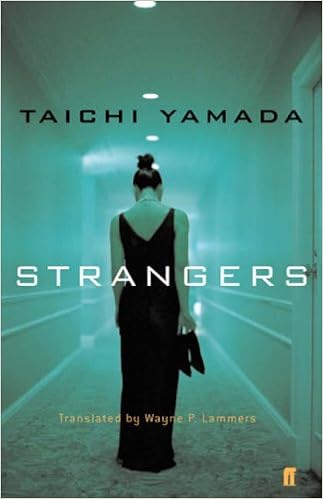
Strangers by Taichi Yamada is a novel written nearly a century after the Hichens story; but it is also a ghost story about emotional withdrawal, emotional blankness. The protagonist is not a bachelor like Guildra; Hideo Harada is divorced and living alone in a flat in urban Tokyo. Into his blank, placid life the ghostly element only gradually intrudes... and when it does the 'ghosts' here are earthy, fleshy, physical beings from Harada's past (saying more would be giving too much away), more real to him than the real people around him. If a good ghost story is about the past reaching for and influencing the present, Strangers gives us a story where the past is physically there alongside the present, just an underground train ride away. A wonderful, unnerving, novel of the uncanny.
11/24/2017
Daniel Braum Nightscript III Interview
My story 'The Affair' recently appeared in Nightscript III, along with stories by many talented authors of the weird and strange. One of them is Daniel Braum, who got in touch and suggested we conduct a joint interview with each other about our respective stories. (Daniel has also organised a night of readings from Nightscript III at the Lovecraft Bar, New York, featuring authors David Surface, Julia Rust & Inna Effress.)Tomorrow, I'll be answering questions on his site about 'The Affair'; below you can see his answers to my questions about his Nightscript tale, the wonderfully creepy 'Palankar'. (I'd never read any of Braum's work before, but 'Palankar' single-handedly convinced me that I needed to rectify that; since then I discovered his story 'A Girl's Guide' which you can and should read here. I'll be checking out his other stories pronto.)
So without further ado...
JAMES: So firstly I wanted to ask you what kind of writer you consider yourself and what kind of story you think 'Palankar' is: do you think of it as a ‘weird tale’, an heir of Aickman’s ‘strange stories’, just plain horror? Or do you think this micro classification of literature is pedantic noise?
DANIEL: I don’t think the micro-classifications are pedantic. I can see so many ways why they don’t matter and for a very long time I knew little of them. Lately I’ve found they can be helpful in terms of my education and efforts to bring stories to readers.
As a writer relatively new to the larger category known as weird fiction, in the course of my recent journey of education I’ve been thinking a lot about “what makes a kind of story that kind of story” for many reasons.
I’ve found one of the more exciting things about ‘weird tales’ and strange stories and horror is how often and how well these stories co-exists with other genres within a single given story. I recognize that any classification varies from reader to reader or author to author. Now that 'Palankar' has been published in Nightscript 3 I feel more confident calling the story a ‘weird tale’ or a strange stories in the spirit of Robert Aickman’s work. I could easily go down a rabbit hole of a discussion entirely about classification. Are weird tales a subset of horror? Are strange tales a subset of weird fiction? Perhaps any classification is an artificial restraint. What I do know is that stories of the kind that Robert Aickman wrote and that appear in Nightscript 3 could easily classify as weird fiction, fantasy, science fiction and or horror and or simultaneously exist alongside any of these labels, which is one of the many reasons these kinds of stories excite me. Even now, knowing a lot more about craft and genre, I still find it helpful to not think about genre when writing- at least not when writing a first draft or the “creation” stage of a story. I feel this helps avoid placing limits on a story and avoids caging it into a notion of what it can or can not be.
So what kind of a story do I think 'Palankar' is?
When I set forth to write 'Palankar' I was attempting to dramatize a notion. I started with this goal not a genre in mind. I wanted to write a story that illustrated a concept or observation on my mind—the notion was that we as humans can only go so far in trying to help or rescue others, particularly those we love, or risk the danger of “drowning” with whom we are trying to help. Thinking about genre didn’t come until very, very late in my process. Often the last part of my creative process is getting peer feedback. When I finally showed the story to others was the first discussion of just what kind of a story it was and what, if any genre it might fit into. Thinking about genre at that time helped me have confidence in my ending.
Right around the time of getting my peer feedback (late 2015) I had recently heard Peter Straub talk about Robert Aickman. Peter Straub’s views on how a Robert Aickman story operates was my gateway to both Aickman’s work and to weird fiction in general. This experience made me realize that my work had a classification or a home after a long time of feeling like it never quite squarely fit as science fiction, fantasy, or horror. The short story 'The Swords' was the story Peter Straub used to demonstrate “an Aickman story”. The story was heavily on my mind during the time I was revising 'Palankar'. I spent a lot of time thinking a lot about why the ending of 'The Swords' works and what kind of story operates in these ways.
Learning that a story not only could be “ambigious” but that there was a whole genre and movement that worked with this concept was exciting and eye opening and provided me with some of the confidence that I could (or in general one could) end a story on a certain point of ambiguity.
JAMES: I thought the ending of your story was very well done: it took the point of view of the brother to the end of his character arc but left so much untold and ambiguous as well. Did you always plan to end the story with unanswered (and perhaps unanswerable) questions?
DANIEL: I didn’t plan it that way. Early on in drafting it I knew the end point of the story would be where my character would have to make a choice—a choice to cross over to a point of danger in his quest to help a loved one.
As I worked with and spent time with the story I realized both the outcome of his attempts to help, his choice, and any “reveal” as to the nature of the phenomenon he experience in the story was not needed to serve or achieve my aim in presenting what I wanted to present in the story.
From what I’ve learned about Robert Aickman it appears that the creation of his stories is an organic process and closely tied to his dreams. For me it is the product of thought and decisions about the characters and a lot of drafting
JAMES: I’m a big fan of ambiguous endings myself (if done right) but do you worry some readers will find them frustrating?
DANIEL: I think the reason I do not worry is because I accept it as cold, hard fact that many (if not most) readers are categorically frustrated with and do not prefer ambiguous endings. Perhaps this is why Aickman is not widely appreciated?
I think this is where classification might come in to play. Classification helps match up readers with kinds of stories they prefer. I think the ending to the movie It Follows is a brilliant ending to a brilliant movie. I would call it a cinematic ‘strange tale’ in the spirit of Robert Aickman. The movie’s ambiguous elements and ending frustrated many viewers. Viewers I spoke with preferred that stories “wrap up” or operate with defined logic and rules as opposed to the “night time logic” the felt but not consciously-known aspect element of Aickman stories, some weird fiction, and certainly the movie It Follows functions on.
I think ambiguous endings work when night time logic is in play throughout the story; when the story operates by rules but they are not overtly given. Stories that avoid traditional structures yet have an emotional ending point, even if that point is a sense of disquiet or something unsettled, I think still operates to feel dramatically satisfying.
I think the ambiguity in your story is a wonderful example of this. It places emphasis on the emotional reality and reactions of the characters and away from overcoming or defeating any antagonist or monster or any defined phenomenon. Returning to the notion of classification, this is one reason the distinction of the strange tale being a type of story all of its own, is both warranted and useful at times.
JAMES: Since both of our stories deal with doubles and duality, it feels apt that our questions should echo each other as well. So what is it about the theme of the double and the twin that appealed to you as a writer? And have you written other stories based on the same trope?
DANIEL: While I wasn’t consciously thinking of doubles or twins when drafting 'Palankar' the notion of two of the same thing or person is fascinating to me. I think there is a wealth of opportunity to show and explore the differences of and importance of choice and choices made. And the notion of the “evil twin” while just being plain fun also lends itself to explore these things. Perhaps the notion of duality is a hallmark or at least familiar ground for weird fiction. In my short stories 'Sumo 21', 'Emperor of Mist' and 'Between Our Earth and Their Moon' ( forthcoming in the anthology Would But Time Await) all explore the consequeneces of meeting / interacting with/ and knowing about one’s otherworldly “double”.
So while I was not consciously thinking of it while drafting 'Palankar' it is something I think about so it makes sense it manifested in the story. Maybe there’s a bit of the Aickman’s subconscious method in me yet!
6/25/2015
Recommendation: The Strangers & Other Writings by Robert Aickman
The earliest piece (from 1936) is called The Case of Wallingford's Tiger and is a story about a pet tiger kept by an Englishman which promptly goes missing. The slight, predictable plot and reliance on dated colonial tropes mean this is the weakest story in the volume; an inauspicious start. Yet, even at this young age, Aickman’s prose shows flashes of his mature style: precise, cool, knowing. The Whistler is a darker tale, which starts to introduce the uncanny and Aickman’s famed ambiguity. But here the ambiguity is, more properly speaking, just frustration. This isn’t the mature Aickman, showing us a picture full-on thus tempting us to think we can decipher it, it’s a young Aickman showing us half a picture knowing full well it isn’t enough.
A Disciple Of Plato seems to suggest a route not taken for Aickman’s fiction, reading more like Henry James than anything else (and I mean the James of The Bostonians say, not The Turn Of The Screw). It’s about a famous historical figure posing as a ‘philosopher’ in 18thCentury Rome, meeting a woman on her way to live in a convent. It’s a decent story, if not spectacular, with Aickman’s prose now fully up to the task of telling it. But there’s a spark, a flair, missing; it’s perhaps for this reason Aickman never wrote more in this vein.
With The Coffin House, things improve dramatically. A short but perfectly formed supernatural tale, it starts with two women on a walk who seek shelter in a strange dwelling… Aickman fans will of course recognise this set up from The Trains, but The Coffin House is very much its own beast, and the steady accumulation of strange, unnerving details is masterfully done. The ending is unexpected, both in terms of the story itself and in the context of Aickman; the twist seems to owe as much to the pulps as Aickman’s more literary influences. But its no less chilling and effective for that.
The Flying Anglo-Dutchman reads almost like a pastiche of Aickman’s more well-known tales: two people encounter ‘the strange’ but are left almost blithely unaffected, more concerned with such mundanely English details like tea and the times of the next trains. There’s something almost wistful about the tone, and it would no doubt be annoying if it were any longer. As it is, it serves as the perfect palate cleanser for the next story…
The Strangers – so here it is. The title story. The motherlode. What we all hoped we’d find in this book but were secretly afraid we wouldn’t – a long (50+ pages), never before published Robert Aickman ‘strange story’ masterpiece. So it feels on first reading anyway. Certainly no one else but Aickman could have written this, with its conventional, staid narrator dragged into events he (and we) scarcely understand, its disturbing yet intriguing visual imagery, its dream-like surrealism rendered even stranger by Aickman’s matter of fact telling. Quite why he never saw fit to include this story in any of the volumes published during his lifetime is a mystery, for it is superb.
The Fully-Conducted Tour is an anomaly, a story written to be read aloud on BBC Radio 4, about the mysterious events that befall a group on a tourist visit to a stately home. It’s an effective piece, with the introduction blurring the lines between Aickman himself and the narrator, giving you the initial impression that Aickman is in fact telling you of something that actually occurred to him. Until events become so strange that you conclude that’s not the case; at least one hopes not.
The two poems in the book, Pimlico and Thea have a similar feel to A Disciple Of Plato about them – slight but promising pieces that indicate a direction Aickman could have taken his writing in, but ultimately did not; which anyone who is a fan of his strange stories must be grateful for. The non-fiction covers a broad range of subjects: films, rivers and waterways, Oscar Wilde, Animal Farm and accounts of supposedly true supernatural occurrences. Naturally it is all well written and interesting, although I suspect the majority of readers will be reading these pieces for what light they shed on Aickman’s life and fiction than the subject matter itself. In this regard Introduction To A Proposed Ghost Story Anthology is most interesting, being a forerunner to Aickman’s fascinating ruminations on the supernatural in fiction that he developed in his introductions to the Fontana anthologies.
Overall then, Tartarus Press should be commended for this volume, which sheds so much light on Aickman’s development and missteps as a writer, as well as providing us with the fine stories The Coffin House, The Flying Anglo-Dutchman, and The Fully-Conducted Tour, along with the stellar, sublime, wonderful The Strangers.
3/01/2015
Recommendation: Nightingale Songs by Simon Strantzas
I've read a number of stories by Simon Strantzas in yearly best ofs and the like, but Nightingale Songs is the first solo collection of his I've tried. Given what I'd read before I was expecting something special, stories literate and creepy in equal measure. And I wasn't disappointed.
But before I talk about the stories themselves, it's regrettable but I must mention that this book had the worst formatting error I've yet seen in an ebook. I say 'formatting' but in fact it was worse than that: the entire ending to a story was missing, and instead appeared as part of the final paragraph of the following story, thus ruining the climax of both. What a shame. (I downloaded the Kindle version over a year ago; hopefully other formats aren't affected and the Kindle version has been corrected by now.)
Anyway, with that unpleasantness behind I can say that the stories that weren't mangled were fantastic examples of strange, ambiguous, supernatural fiction. Aickman's influence is often to the fore, fortunately not in a superficial way - indeed second story Her Father's Daughter may well be the best example I've read of a writer assimilating Aickman's influence whilst retaining their own voice. A story that combined elements of both feminist and Freudian psychology (although Aickman hated Freud) into a compelling psychic landscape of strange car accidents, reclusive sisters and a flatly ambiguous ending, this was one of the best stories I've read so far this year.
Other highlights included Pale Light In The Jungle and An Indelible Stain Across The Sky (what a title!) which owed something to Ramsey Campbell's style of paranoia built from metaphoric connection whilst, again, remaining completely Strantzas's own story. Mr. Kneale by contrast was a black, black comedy taking swipes at literary conventions and success, but still having a core of horror beneath. Nearly all the stories were impressive, and personal favourites will likely vary. Only Everything Floats was a slight disappointment to me, beautifully written and atmospheric but building towards an ending all too predictable.
An excellent collection, then. I notice Strantzas has had another collection of short stories released since Nightingale Songs, and given how satisfying these tales were I'll surely be picking that up soon.
6/29/2013
Review: Night Voices - Robert Aickman
It starts brilliantly - The Stains is a classic Aickman story, with his trademark slow build, exquisite prose, and tantalising symbolism. That sense that more is being implied that is said. It's a showcase of Aickman's ability to delineate a realistic, English setting and characters but yet evoke a faint, surreal sense of disquiet. I don't want to spoil the plot, but I will say the stains themselves are one of Aickman's more hideous little touches.
Just A Song At Twilight is almost as good; a shorter tale with an ending that took me by surprise. I like the fact that Aickman can still surprise me; that I don't yet know all his tricks and techniques. This is the first one I'll reread, seeking out all those tantalising Aickman details...
After that strong start, I have to say the rest of the short stories were definitely second-rate (the presence of The Trains is missed). Aickman, even second-rate Aickman, is always worth reading and his prose is always a pleasure, but I found Laura a somewhat derivative retelling of a common supernatural trope, and I must confess that all I took from a Rosamund's Bower was a sort of pleasurable bafflement. Mark Ingestre: A Customer's Tale is better, another of Aickman's patented 'strange stories' but not quite first-rate, covering themes Aickman did better in his masterly The Swords. Nevertheless it's a suggestive tale and the historical setting is a nice change.
The novella The Model is an interesting read, but nothing like Aickman's other fiction, being a picaresque tale set in pre-revolutionary Russia, about a young girl who wants to be a ballerina. It's not a realistic piece, having a dream-like, fairytale atmosphere. It was a lovely journey, but I can't say I felt I actually arrived anywhere.
The non-fiction section of the book largely consists of Aickman's series of introductions to the Fontana Book Of Great Ghost Stories series, which he edited. Taken together, they form a virtual manifesto of the ghost story, which Aickman is at great pains to distinguish from the horror story. Although I disagree with a lot of what he says, the manifestos of geniuses are always fascinating. Suggestive ideas abound; I will quote just one:
"I should like to suggest that the now the word 'ghost' should be seen more as the German geist: that ghost stories should be concerned not with appearance and consistency, but with the spirit behind the appearance..."
These essays are full of such gems, and any writers of horror (sorry, Robert!) are certain to find much to think over, much inspiration.
Overall, this book is like one of those rarities albums bands release when they're no longer together - interesting to the fans and obsessives, but hardly the best place to start for someone new. Night Voices contains much of Aickman's brilliance but, for this reader, some misfires and duds as well . If you're new to Aickman, start with Cold Hand In Mine or Dark Entries. But if you're already under his spell, you'll find nothing in this volume to break that spell; Aickman was one of the best there's ever been, it's simple as that.
3/19/2013
Robert Aickman Word Clouds
So, I've been participating in a fabulous group read of The Wine Dark Sea by Robert Aickman - no need to explain to regular readers how much I admire Aickman's stories, I'm sure I've banged on about him often enough...
Anyway, I wanted to do a post about some of the stories in the book, and I've decided to do something a bit different. Because reading Aickman is so subjective I'd hesitate to offer my interpretation of one of his stories as definitive; so (with their permission) I've decided to use other people's words from the group read to create these 'word-clouds' for the title story and for The Trains. The phrases are just ones that struck me from the discussion, be they people's view on what the story meant, or other stories it reminded them of, or whatever. The idea was to get a more impersonal, multi-layered, ambiguous description of each story than if I'd just waffled on myself.
I think the results look quite good, and if there's a positive response I'll probably do a couple more.
![]() |
| The Wine Dark Sea |
![]() |
| The Trains |
10/30/2012
Big Bulky Horror Novels for Halloween
Halloween is an odd time of year, when people who never normally watch horror movies or read ghost stories seem to find an excuse to do so. The webpage of a national newspaper might discuss a short story by Robert Aickman, and a respectable broadcaster might devote an hour to an informed discussion of European horror films.
I'm probably guilty on this blog of discussing the more obscure aspects of horror fiction, at the expense of commercial books that a wider audience will have heard of. So in tribute to Halloween and the temporary mass celebration of all things scary, I've decided to do a post on my favourite BIG horror best-sellers. These were the kind of books that introduced me to the genre when I was a teenager and it’s unlikely I’d be reading Aickman & Co. if I’d not read the likes of King and Simmons first.
I've imposed some strict rules on my selections here: no tricksy post-modernism (sorry, House Of Leaves); no psychological ambiguity (bye bye Turn of The Screw and Hill House); nothing old (stop moaning, Doctor Jekyll And Mister Hyde) and no short stories or novellas (adiós just about every weird, under-appreciated book I've ever featured here). Instead, these are the block-busters. The writers of cracking action scenes with unambiguously evil villains. At least three have been made into movies, and the other two should be.
I guess it’s obvious from the above that this list would include King, so I thought I might as well start with him. IT is probably my favourites of his horror novels, and it exemplifies the kind of book I'm talking about here: vast, with a sprawling cast of characters, and a ‘big bad’ who has been responsible for decades of fear in the Maine town (of course) of Derry. The story takes place across two timelines – the characters repeat scenes from their childhood as flawed and weaker adults… King’s handling of this, and the creepy effects associated with time repeating itself, are a highlight of the novel and really call into question those people who think he can’t write with any subtlety. (Just because the books I'm talking about here are big bulky blockbusters doesn't mean they’re big bulky dumb blockbusters.)
For me, Ghost Story is Straub’s best book by a country mile – forget the singular title, this book should really be called Ghost Stories, containing as it does multiple stories told by a group of old men know as the ‘Chowder Society’. Straub takes the Stephen King approach of using an American small town as a setting for his horrors, and as a microcosm of society as a whole, but this is distinctly his own style. As the story progresses it becomes clear that each of the individual ghosts and monsters are just facets of the real evil; that each of the separate stories being told, are in fact just elements of one story after all.
Probably the most ‘arty’ book in this list, and arguably not horror, being told as it is from the point of view of a monster. But there are bigger monsters in this tale than the vampire doing the talking, and the real horror may be the slow falling away of his humanity… I like this book for it’s lavish set pieces (the whole book is nothing more than a series of set pieces, really) and the darkly luxurious feel of the prose, particularly in its descriptions of night-time New Orleans and Paris. Maybe this was the start of the trend towards Twilight and everything bad associated with that, but here the vampires still have a decadent, almost nihilistic edge. (Everything else I've read by Rice, including the sequels to this, I've not liked at all.)
An absolute whopper of a book, which has a premise that makes it sound like the worst tripe imaginable: ‘mind vampires’ have been controlling human affairs for decades. But this was back when Simmons was at the top of his game (by contrast his last book was one part plot to nine parts Tea Party ranting) and he plays the idea of mind vampires with a completely straight bat. They become almost the ultimate villain, responsible for humanity’s evils both big and small. And like all the best villains they are completely compelling. The odds seem ridiculously stacked against the human heroes and despite the simple good versus evil plot, the book has an air of desperation in places that makes it stand out.
The most recent book on the list and yet another one about vampires. I don’t know if Lindqvist has read Interview With The Vampire, but given it’s English-language ubiquity it at least seems likely he might have. One of the minor characters in that book might have been the inspiration for this one – a child vampire. A creature that has lived for centuries but still has the body of a kid. In some ways this is the darkest of the books in this list, with its setting of an 80s Swedish housing estate, and its background themes of addiction and child-abuse. In this setting the child-vampire is only partly horrific, and the tale of her relationship with a lonely schoolboy has a real emotional core, twisted and bleak, but there. The kind of book that gives best-sellers a good name.
Feel free to mention your own big bulky favourite horror novels in the comments...
6/18/2012
A Dream about Robert Aickman
Last night, I dreamt I was in a bookshop. All the books were on rotating carousels; they were square and very thin with covers seemingly made of canvas or some sort of woven fabric. They only displayed the author’s name on the front, not any titles, and to tell who the book was by you had to run your fingers over the embossed writing like Braille.
I was turning the carousel looking through the books and I wondered why there weren't any by Robert Aickman. As soon as I thought this, the carousel (which turned of its own accord) presented a book to me; I traced Aickman's name on the cover and then opened it.
All the pages were folded into each like the leaves of a map, but a thousand times more complicated and intricately layered. As I unfolded more and more pages I held them up to the light, and the paper was tough but almost see through, like an insect's wing. Each page spawned more and more pages. The next might have writing in all the alphabets of the world, or diagrams that drew themselves, or colourful illustrations like the Book Of Kells, or brand new periodic tables, or anatomical drawings of imaginary creatures.
I looked around the bookshop, and all the other people there had similar books open, their open pages unfolding and connecting like paper streamers between us. Everyone was smiling and everyone was reading, and I knew I’d never be able to shut the book that was opening and opening in my hands.
Subscribe to:
Posts (Atom)