Showing posts with label Non Fiction. Show all posts

9/28/2024

Millionaires Day

So, Kit Power's latest book is an odd one, even for him. You'll have seen the title of this post - "Millionaires Day" - and already had a reaction I'm sure. Either you remember that day vividly (despite the fact that, post-Covid, no one ever seems to talk about it) or you'll be denying it ever happened, that it was all just internet bollocks. Two tribes.

I was reluctant to even post this piece, to be honest. I'll probably not check my DMs for awhile after it goes live.

But Kit's wrote a whole book about it, so god knows what his messages are going to be like.

The book's being marketed as 'fiction' for reasons obvious to anyone who's spent any time on the internet (especially that message-board...) so, yeah - fiction. Sure. So as part of Kit's research for his FICTIONAL book he asked some fellow writers to send him their FICTIONAL recollections of that time. I don't know in what mischievous and ingenious ways Kit will have used what I sent him, but I thought I'd post the original piece on here to help promote Millionaires Day (which is being formally launched at FantasyCon in Chester in a few weeks). 

So: this is just a piece of make believe, if that's what you want to think. Just a story. Don't @ me.


#millionairesday

Did it happen? I remember it happening, but when I look online, at what other people apparently think they remember, I’m not sure how much proof that is.

When I go outside to my—well, it’s not a garden, but the few metres of dead grass I call a garden—when I go outside to the garden, I still expect to see the black scorch marks. Look up and I still expect to see smoke, and that the sky might snow this winter. But there are no scorch marks, and we’ve fucked the weather too much for snow.

But what I do remember is this: how surreal it seemed, after having made a cuppa from yesterday's reused tea-bag, after having checked the expiration date on the dried noodles I’d got from the food-bank despite the fact that I'd nothing else and would have to eat them regardless… - I remember how surreal it felt to find all that money under my sagging bed. Finding a tenner would have been cause for celebration; finding all that—I felt elated, but scared too, almost. Like something had gone wrong and I’d be held accountable.

I unlocked my phone, to open social media—because that’s what you do, isn’t it, when something special or untoward happens? You check social media. But it was down, all of it. Every site. I reasoned I’d just not paid some bill or other. I looked again at the case of money under my bed; I could pay those bills and debts now. More importantly, I could eat.

But I still felt uneasy. Like when someone gives you something and you’ve not got a gift to give them back. Or like when you have to go to a food bank.

I took some of the money, planning to buy a load of booze—and I mean a load—and food. It was only when I left the house I realised that what had happened to me hadn’t only happened to me. Already half he shops were shut as the owners partied, and in those that remained open the prices—felt-tipped over the original, printed ones— looked as surreal as the cash under my bed had done. I bought the booze but not the food; back home I had vintage Champagne and Hakushu whisky and dried, out-of-date noodles… and I felt a bitterness as I heard the cheers and whoops from outside. Everyone else was doing the same as me, minus the noodles. I’d felt special for a moment, different, but barely hours later I was back to being the same as everyone else, but shitter.

I remember, I’m sure I do, that I took the case of money outside to the ‘garden’, poured BBQ fluid over it, and set it alight. As the black smoke rose into the sky I looked up and saw that it had started to snow—in my drunken vision it looked like a blizzard and it was like I’d caused it, like because of me we’d have a white Christmas. Because of me.

And then I saw the swirls and eddies of black smoke rising up all over the estate, and I shouted swear words at all the other fuckers, all the other trapped fuckers like me running down the same rat-runs, and then I must have blacked out or passed out—stupid, I don’t even like Champagne—and when I woke up my tiny garden was blackened and sooty, but the sky, the sky was still snowing and we did have a white Christmas, all of us, despite what the weather records say that year.

That’s what I remember.


10/20/2020

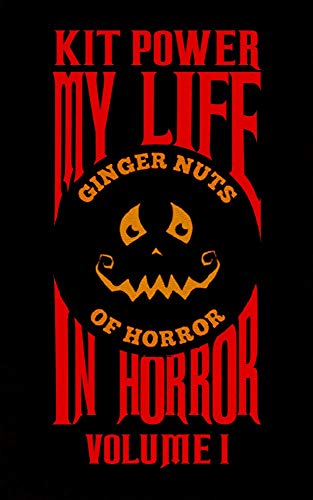
Recommendation: My Life In Horror #1 by Kit Power

Kit Power's My Life In Horror #1 is a non-fiction collection of essays originally published on Gingernuts Of Horror. In each, Kit describes a formative encounter with the horror genre in his childhood or young adulthood: not just books and films, but also music, a role-playing game, and real-life events. Kit's definition of what counts as 'horror' is pretty flexible, which makes for some delightful surprises in what he's included—as well as Hellraiser we get Robocop, as well as The Wasp Factory we get Sleepers. I thought I'd already read most of the content, but it turns out there was quite a lot I'd missed, especially where they relate to music. As an aside, Kit is very good writing about music, making we want to listen to tunes I either doubt will be to my taste (The Wildhearts) or even already know I loathe (bloody Queen). 

Kit and I are of a similar age, so I encountered a lot of the works he mentioned in my youth too (and I was struck by the notion, hinted at throughout the book, that the news we see as kids influences our view of horror as much as fiction; that footage of Hillsborough, Zeebrugge, the Challenger explosion, or the Ethiopian famines, form a bedrock of shared cultural experience and imagery similar to liking the same films) but I suspect nearly all fans of the genre will get a kick out of these pieces. And...

.... and, oh look, who am I kidding? This isn't how I wanted to write about this book.

There's a great moment in B.S. Johnson's Alberto Angelo where he interrupts his own novel by saying "fuck all this lying" and proceeds to tell the supposedly real-version of events that inspired the fiction up until that point. And while I've not been lying above, I have been circling round the real reason I loved this book: 

It's 2020.

It's Covid-time.

I haven't seen my writing friends in months, nor am I likely to for months more.

Like many I'm sure, my writing has taken a hit this year. My routine's all changed, I've lost some mojo. And part of it is that the conventions are cancelled, those semi-regular catch ups with fellow authors. I'm sure I'm not the only one who gets a burst of motivation & enthusiasm following Fantasycon or Edge-Lit, and while some of that is from the scheduled events, a lot is from being surrounded by so many amazing writers and fans and creatives, from talking to them during the day and well into the night.

Reading My Life In Horror feels as close to one of those conversations as I'm going to get this year. Indeed, the first chapter is about Stephen King's IT, and one of my favourite FCon memories is a late night conversation with Kit and Mark West when we talked about how much we loved IT for hours. And the great thing about this book is it's so personal, so much Kit's take of the horror genre, that it feels like a one-way conversation with him. My responses to the essays in the book weren't objective judgements, but me thinking what I would want to say back to him, if I could. (You're so wrong about Don't Look Now, Kit.)

In a very real way, it's fired me up like a convention would (I even read it Friday to Sunday, the same timescales as Fcon) and made me want to get back to my own writing, to my own life in horror. So it's pointless for me to pretend to describe this book like I did at the top of the review, to compose an objective sounding discussion of its many strengths and odd weaknesses. 

My Life In Horror #1 was quite simply just what I needed right now, in 2020, and it might be just what you need too. 

10/02/2014

The Story Behind The Book Volume 3

A quick one to say that my non-fiction piece about some of the inspirations for my most recent collection of short stories, The Story Behind Falling Over, has been published by those good folks over at Upcoming4Me in the book Story Behind the Book : Volume 3 - Essays on Writing Speculative Fiction.

All the proceeds from the book go to the charity Epilepsy Action, and it includes pieces by a whole bunch of ace writers including Christopher Fowler, Eric Brown, Garry Kilworth, Steve Rasnic Tem, Ian R. MacLeod, Pat Cadigan, and a whole lot more. What's not to like?

You can buy the book from Amazon UK (Kindle | Paperback) and US (Kindle | Paperback).

6/10/2013

Vortex by Robert Dunbar

On the day I was born, the headline in The Daily Mail was "WEREWOLF KILLER CAUGHT."

This is just one of many things I have learnt from Robert Dunbar's new book, Vortex.(UK | US)

Vortex is a non-fiction book, and it is Dunbar's personal exploration of the roots of many of contemporary horror's best known beasts, plus a few lesser known ones as well. From the Jersey Devil to vampires, from sirens and mermaids to were-creatures of all kinds, Dunbar examines the roots behind these legends - how the stories have changed over time, and how they have remained the same. There are also some chapters on film, the most interesting being the one about the theme of 'the other' in horror movies - which groups society marks out as its 'monsters'.

Regular readers will know that Dunbar is one of the favourite horror authors I've discovered in recent years, so I wasn't surprised to discover how well written Vortex is. However, the tone is very different to his dense, thoughtful fiction, being a witty and frequently self-mocking read. It's certainly no dry-as-dust academic piece; in fact given that half the time he's talking about real life cannibals or witch-burnings or mass-murders, it's a very gleeful book. My favourite section was that about The Jersey Devil, a monster Dunbar has made very much his own in an early novel, in a deliberate attempt to move away from the over-used, over-European monsters that still rear their heads in such a great deal of horror fiction. Being a boring old European myself, this was all new to me. Like many other parts of this book, I learnt a lot, and had a blast doing so.

So, a thoroughly engaging and enjoyable ride through some of the most horrific myths and real-life events imaginable. Very much recommended for anyone with an interest in Dunbar's work, or in horror fiction in general. There were some sections I wish were longer and went into more detail, but maybe I'm just wishing for a sequel.

Here's a little trailer to watch, for those who wish to do so:

1/16/2013

Strange Story #20: House Of Leaves

Strange Story #20: House Of Leaves
Author: Mark Z. Danielewski

Make no mistake, those who write long books have nothing to say. Of course those who write short books have even less to say...


Most of the strange stories I've featured in this column to date have been short, controlled tales – paranoia and fear mounting to a single moment of horror. Whilst the best of these stories might imply a lot, they definitively state very little.

House Of Leaves is not that kind of story.

This is a huge novel (and one you must read in its physical version rather than as an ebook, as the photographs in this post will indicate) with multiple plots and sub-plots, typographical tricks, footnotes and diversions. It tells the story of ‘The Navidson Record’, a film by a renowned photographer about a very singular house.

The book takes the form of an academic treatment of the film, discussing its themes and veracity. This has apparently been written by Zampano, a blind man who dies in mysterious circumstances. His manuscript is recovered by a second character, Johnny Truant, who interprets the Zampano notes and The Navidson Record in his own way, as well as chronicling the breakdown he suffers whilst reading the material, despite the fact that he can find no evidence that the film even exists.


So the book is in effect one narrator annotating the notes of another narrator about a film neither can ever have seen (one doubting it is real, the other being blind) and that even if it does exist might just be a fake anyway. I think.

Added to this, the book is a labyrinth (and that word is chosen deliberately) of other stories, from Johnny’s tall-tales told to impress girls to historical accounts of people shipwrecked in the Arctic. The book also features seemingly never-ending lists (of architectural features, famous photographers, ghost stories etc.), mirror-writing, poems, and letters with a secret code. There are 'quotations' about the Navidson Record from people like Derrida, Camile Paglia, and Stephen King. There are a number of seemingly trivial mysteries that nevertheless prey on the mind: why is the word house (or any translation thereof) in a different colour & font to the rest of the text? Why is every reference to the Minotaur myth crossed through?

This book achieves ambiguity not through sparseness of detail but through a surfeit of it.

And there remains the fact that, despite the interruptions and longueurs, there is at the core of this book a truly frightening and original horror story. The Navidson Record starts with the Navidson family moving into a new house, and Navidson realising his house appears to be a fraction of an inch bigger on the inside than the outside: Lovecraft’s crazy geometry rewritten on a domestic scale. Soon after, a door appears in the house that wasn't there before, that appears to open onto a small, dusty corridor… which is clearly occupying the same physical space as the garden outside the house. Navidson, and later others, explore the corridor, and they soon realise the space behind the door is potentially huge (infinite?), and shifting and protean... and there might be something in that impossible space with them. The sheer impossibility of the house, initially represented by that small fraction of an inch, becomes something experienced on a far vaster scale. Added to this is the very human drama played out between Navidson and his wife Karen, who desperately wants her husband to stop exploring the house, and between Navidson and his estranged brother Tom. The book contains several moving moments of catharsis as well as it's brain-frying detail.


House Of Leaves seems to me a stunning achievement, a book that will become a true classic of the genre (despite the fact that no genre can really contain it). It meshes post-modernism with a strong knowledge of horror tropes, and comes up with something absolutely original. It contains enough intellectual stimulation to fuel a thousand post-graduate essays, but with enough twists and turns of the plot to turn it into an addictive page-turner too. Despite its size it’s compulsively readable, and re-readable – I've read it three times now and found new pleasures and confusions each time.

In fact, typing this, it occurs to me it's a love story, too.

Absolutely essential reading.

9/29/2011

Horror Stories: What's In The Box?

Iain Rowan has posted a good review of The Shelter over at his blog - when I say a 'good review' I don't mean he liked it (although he did, thank goodness) but that it was an informative and perceptive piece, saying many interesting things about horror fiction. I was particularly struck by this:

Horror fiction often disappoints me, as the suspense and dread rises, but then you see the monster, and...is that it? 


This immediately made me think of Stephen King's wonderful non-fiction book Dance Macabre where he makes a similar point about horror - you throw open the door to reveal the monster and the reader thinks 'A ten foot ant! Yikes quite scary! But I can cope with that... Now a 100ft ant, that would be scary...' But of course, if what was behind the door was a 100ft ant, the reader would be thinking: Scary! But I can cope with that...


The image I have in my own head is of a jack-in-the-box - as a horror author, you better have something good springing out of that box. (And that thought always makes me hum this song, but anyway). 

All of which has got me thinking, what are the different ways horror authors solve this problem? Seems to me it's these:

1. Pretend There Isn't A Problem
Maybe, if you're a really skilled author, and having a really good day, you can still get away with writing a story where the big reveal is basically "Boo! It's a vampire!" Maybe.

2. Monster With A Twist
This one is quite common - vampires that turn into a snake not a bat, zombies that run etc. It can be done well   - vampires have been reinvented scores of times, the most recent high-profile case being Let The Right One In. When it's done well it works - the twist creates a frisson of shock, and allows creatures grown dusty with familiarity to be scary once more. But it's damn hard to do, and one suspects there's more failures than successes. Do it badly, and it's apt to seem to the reader like a cheap gimmick rather than anything they should react to, let alone be scared by.

3. Invent A New Monster
If ghosts, werewolves, vampires, aliens and zombies (and alien zombies) are all seeming too stale, then the best thing to do is invent a new monster, no? The reader can't have a jaded reaction to something they've never encountered before can they?

Well no. But there's little new under the sun. Dance Macabre time again (and if you read or write horror and haven't a well-thumbed copy of this on your bookshelf then you really need to examine your life choices up to this point) - King talks about the books Psycho and The Strange Case of Dr Jekyll and Mr Hyde as werewolf novels. Werewolf novels? 

Yes, because the really scary thing about werewolves isn't the teeth or fur, but the fact that those guys walk around most of the time looking just like you and me. As does Norman Bates when he's not in his dead mother's dress; as does the respectable looking Mister Hyde. The scary thing is they look normal but can change.

So if you want to create a new monster for your story, be careful. In reality, this method is likely to be identical to Number 2.

4. Only Partially Reveal Your Monster
Now we're talking. I do this one quite a lot - letting the reader glimpse the thing out of the corner of their eye, throwing in some choice description but leaving most to the imagination. The idea being, if the unknown is what's scary, keep it a bit unknown. Lovecraft was a master at this - how many of us could really say exactly what Cthulhu looks like?

Be wary though - if done clumsily this approach can seem to the reader to be a cheap trick.

5. Ambiguity #1: Call Into Question Just What The Real Monster Is
Just because you've revealed what everyone thinks the monster is, it doesn't mean they're right. Maybe it's just an aspect of the real Big Bad. Think Ghost Story by Peter Straub which gets all sorts of ghosts and monsters and scary kids roaming around, but they're all just reflections of the real monster... and of ourselves. You can keep the tension tight if the reader is never sure which reveal is the big one.

6. Ambiguity #2: Call Into Question If The Monster Is Even Real 
Another one I really like. What if it's all in the protagonist's head? Isn't that more scary than a monster, in some ways - especially if you're not sure? The obvious example here is The Turn Of The Screw (ghosts are the perfect monster for this type of horror) but it doesn't have to be as overt as that; a lot of horror can be read in this way.

7. Make The Monster Relevant To The Characters
There's tons of good examples of this one, but to pick a familiar one: in The Exorcist the priest has to determine whether the girl is really possessed by a demon, or just faking or suffering some psychological trauma. But here's the turn of this screw: the priest is losing his faith in God. But if the demon is real, if Evil with a capital E is real, then surely Good with a capital G is too? The priest almost wants the demon to be real... (which dovetails nicely with technique 6. above).

8. Don't Have A Monster
Guess what? Horror doesn't need a monster. Horror needs dread, unease, fear; horror needs... well horror. And a good author can generate this without a bogeyman. To end with an example of my own, A Writer's Words in my collection The Other Room has no psycho-killers, no mutants or mummies. What it does have, hopefully, is a creepy sense of unease as an almost existential situation overtakes the main character. And somehow, with this kind of horror story, where there's no monster as such, the reveal can be seamless.

So, fellow horror authors, what do you think? Have I missed any out? In reality of course authors mix and match these approaches to the issue of opening the box, or the door, to reveal what's been lurking.


In other news, I'm taking part in a 'blog hop' running from 24th to 31st October, where I'll be giving away some books and maybe other stuff if I can work something out. (If you aren't sure quite what a 'blog hop' is, like I wasn't, check out this post from Belinda Frisch, which explains it better than I could.)

If you're a fellow horror author (and let's face it, if you've read all of blog post so far there's a good chance you probably are) and want to take part, check out the Coffin Hop webpage.