Showing posts with label in defence of short stories. Show all posts

11/02/2011

The Scattershot Writing Horror Anthology - As Chosen By You...

So I thought it would be interesting to list all the stories suggested in my competition post below - consider this some kind of ultimate Scattershot Writing anthology of goodness:


Robert Aickman: The Cicerones
Clive Barker: In The Hills, The Cities (2 votes)
Clive Barker: Tortured Souls
Algernon Blackwood: The Willows
Ray Bradbury: The Foghorn
Ray Bradbury: Mars Is Heaven
Ray Bradbury: The October Game
Poppy Z Brite: The Sixth Sentinel
Truman Capote: Miriam
Harlan Ellison: Jeffty is Five (2 votes)
Harlan Ellison: Sensible City
Neil Gaiman: Other People
Neil Gaiman: The Price
Charlotte Perkins Gilman: The Yellow Wallpaper (2 votes)
Elizabeth Hand: Cleopatra Brimstone
M John Harrison: The Incalling 
Joe Hill: The Cape
WW Jacobs: The Monkey's Paw
Shirley Jackson: The Lottery (2 votes)
MR James: A Warning To The Curious
Kafka: Metamorphosis
Stephen King: Chattery Teeth
Stephen King: Mrs. Todd's Shortcut
Stephen King: Survivor Type
Neil LaBute: Iphigenia in Orem
Fritz Leiber: Smoke Ghost
Robert Leman: There Are Feesters In the Lake
Kelly Link: Louise's Ghost
Kelly Link: The Hortlak (2 votes)
HP Lovecraft: The Colour Out of Space
HP Lovecraft: The Rats In The Walls
HP Lovecraft: Pickman's Model (2 votes)
Arthur Machen: The White People
Richard Matheson: Born Of Man And Woman
Joyce Carol Oates: Family
Joyce Carol Oates: Smother
Edgar Allen Poe: The Pit And The Pendulum (2 votes)
Edgar Allen Poe: The Raven
Edgar Allen Poe: The Tell Tale Heart
Aaron Polson: Tesoro's Magic Bullet
Jim Shepard: The Creature From The Black Lagoon
Michael Marshall Smith: What Happens When You Wake Up In The Night
Margaret St. Clair: Horror Howce
Theodore Sturgeon: It!
F Paul Wilson: The Barrens


Well if it was a real anthology I'd buy it. You guys sure have good taste... I think everyone who contributed managed to list both stories I really love, and some that were new to me. Definitely some ones I will be checking out. Bradbury, King, Lovecraft and Poe were the most popular in terms of numbers of stories nominated.

We'd also have to find room for these less than precise suggestions:


"[Can't remember title*] by Richard Matheson * sure it has a child, locked in a room, and faces painted on the wall with glow in the dark paint, not Born Of."


"A story about people in the arctic purposefully freezing and amputating their limbs that I am sure I read at chizine.com but which I can find no mention of. "

"A lot of Ligotti stories." 

10/23/2011

Coffin Hop - Tales From Around The Camp Fire


Halloween is almost upon us, and that can only mean one thing - annoying teenagers who aren't even in costumes wanting money and sweets from me all week.

Oh no, two things: annoying teenagers and horror stories.

This post is about horror stories, and is my contribution to the Coffin Hop blog tour - if you check out their site you'll see all the authors involved, and the best thing is they're all giving prizes away. As am I... read on to find out more.

But anyway, horror stories; ones told around a camp fire by a group of kids, each trying to outdo each other, each swearing their story is true. Stories called things like The White Lady; The Killer In The Backseat... and The Hook.

And despite all the literary sophistication that we horror authors try to bring to their tales, I like to think at heart we're all just kids around that camp fire, each trying to make people believe that no, really, this actually did happen.

But sometimes the stories we tell say more about ourselves than we realise:.

Some Stories For Escapists #4: The Hook

 - “OK, I’ve got one, I’ve got one. There’s this boy and girl right, and they’re going somewhere in this car to get off with each other, like The Drop right? And…” 
- “That’s where my brother goes with his girlfriend, when Mum wouldn’t let him in the home with her after…” 
- “Your brother aint got no girlfriend, he just goes up The Drop with a Razzle!” 
 [Laughter]
- “Right, so they’re up there and snogging and it’s all dark and he’s got his hands on her tits and the radio’s on and in between songs this guy says, the news guy, there’s been a break out from the local mental home, which is right near where they are. Some psycho's escaped, and instead of a hand right, he’s got this hook, real sharp, which he uses to kill his victims, rippin’ up their guts. That’s what the radio says, and they’re still snogging each other, but she’s scared now, typical girl, thinking the killer might be around. ‘Let’s go home,’ she says, ‘Get off me, I want to go home.’ He doesn’t want to but she keeps sayin’ it, ‘Get off, I’m scared, let’s go, get off me!’ So he eventually lets her go and speeds off, real fast cos he’s pissed off right. And when they get back they find, in the driver door handle, this ripped off hook…” 
 [They all stare into the camp fire]
- “Your brother really get her pregnant?” 
- “Yeah. My parents gonna kill him!" 
- “Didn't he use a johnny?” 
- “Dunno.” 
- “He shoulda done it to her when she had her period. You can’t get pregnant then.” 
- “No, aint it after she’s had it?” 
- “How would you know, you aint even kissed a girl!”
[They all pause and stare into the fire] 
- “You don’t even know what a period is.” 
- “I do, my sister told me!”
- “What is it then?” 
 [Pause] 
- “I aint telling you lot!” 
[Pause] 
- “Do they really bleed? The first time you… Do they really bleed?”
[Pause] 
- “My mum’s gonna kill him.” 

Anyway, competition time. As regular readers will know, I've had some great guest bloggers on here to celebrate the art of the short story. And I think horror is one genre particularly well suited to short stories; I love reading  good anthology of horror stories by a host of different and varied writers.

So the competition is to make up your ultimate Horror Story Anthology. For every one that contains some stories I love, or that are new to me but that I rush out and buy, I'll give that person a free download of my horror novella The Shelter. And for the one I judge the absolute best, I'll also give a free download of my collection The Other Room. (All entrants are also very welcome to a copy of First Time Buyers  but as that's currently free anyway that's not much of a prize!)

The rules:
1. Leave a comment containing a list of the 5-10 stories that make up your anthology - you're favourite horror stories of all time
2. Any horror or horror-ish story welcome, as long as you didn't write it yourself
3. Anything from 100 to 15k words I'll consider a short story for the purposes of this competition

Good luck. And don't forget to check out the other authors on the Coffin Hop blog tour...!

9/29/2011

Horror Stories: What's In The Box?

Iain Rowan has posted a good review of The Shelter over at his blog - when I say a 'good review' I don't mean he liked it (although he did, thank goodness) but that it was an informative and perceptive piece, saying many interesting things about horror fiction. I was particularly struck by this:

Horror fiction often disappoints me, as the suspense and dread rises, but then you see the monster, and...is that it? 


This immediately made me think of Stephen King's wonderful non-fiction book Dance Macabre where he makes a similar point about horror - you throw open the door to reveal the monster and the reader thinks 'A ten foot ant! Yikes quite scary! But I can cope with that... Now a 100ft ant, that would be scary...' But of course, if what was behind the door was a 100ft ant, the reader would be thinking: Scary! But I can cope with that...


The image I have in my own head is of a jack-in-the-box - as a horror author, you better have something good springing out of that box. (And that thought always makes me hum this song, but anyway). 

All of which has got me thinking, what are the different ways horror authors solve this problem? Seems to me it's these:

1. Pretend There Isn't A Problem
Maybe, if you're a really skilled author, and having a really good day, you can still get away with writing a story where the big reveal is basically "Boo! It's a vampire!" Maybe.

2. Monster With A Twist
This one is quite common - vampires that turn into a snake not a bat, zombies that run etc. It can be done well   - vampires have been reinvented scores of times, the most recent high-profile case being Let The Right One In. When it's done well it works - the twist creates a frisson of shock, and allows creatures grown dusty with familiarity to be scary once more. But it's damn hard to do, and one suspects there's more failures than successes. Do it badly, and it's apt to seem to the reader like a cheap gimmick rather than anything they should react to, let alone be scared by.

3. Invent A New Monster
If ghosts, werewolves, vampires, aliens and zombies (and alien zombies) are all seeming too stale, then the best thing to do is invent a new monster, no? The reader can't have a jaded reaction to something they've never encountered before can they?

Well no. But there's little new under the sun. Dance Macabre time again (and if you read or write horror and haven't a well-thumbed copy of this on your bookshelf then you really need to examine your life choices up to this point) - King talks about the books Psycho and The Strange Case of Dr Jekyll and Mr Hyde as werewolf novels. Werewolf novels? 

Yes, because the really scary thing about werewolves isn't the teeth or fur, but the fact that those guys walk around most of the time looking just like you and me. As does Norman Bates when he's not in his dead mother's dress; as does the respectable looking Mister Hyde. The scary thing is they look normal but can change.

So if you want to create a new monster for your story, be careful. In reality, this method is likely to be identical to Number 2.

4. Only Partially Reveal Your Monster
Now we're talking. I do this one quite a lot - letting the reader glimpse the thing out of the corner of their eye, throwing in some choice description but leaving most to the imagination. The idea being, if the unknown is what's scary, keep it a bit unknown. Lovecraft was a master at this - how many of us could really say exactly what Cthulhu looks like?

Be wary though - if done clumsily this approach can seem to the reader to be a cheap trick.

5. Ambiguity #1: Call Into Question Just What The Real Monster Is
Just because you've revealed what everyone thinks the monster is, it doesn't mean they're right. Maybe it's just an aspect of the real Big Bad. Think Ghost Story by Peter Straub which gets all sorts of ghosts and monsters and scary kids roaming around, but they're all just reflections of the real monster... and of ourselves. You can keep the tension tight if the reader is never sure which reveal is the big one.

6. Ambiguity #2: Call Into Question If The Monster Is Even Real 
Another one I really like. What if it's all in the protagonist's head? Isn't that more scary than a monster, in some ways - especially if you're not sure? The obvious example here is The Turn Of The Screw (ghosts are the perfect monster for this type of horror) but it doesn't have to be as overt as that; a lot of horror can be read in this way.

7. Make The Monster Relevant To The Characters
There's tons of good examples of this one, but to pick a familiar one: in The Exorcist the priest has to determine whether the girl is really possessed by a demon, or just faking or suffering some psychological trauma. But here's the turn of this screw: the priest is losing his faith in God. But if the demon is real, if Evil with a capital E is real, then surely Good with a capital G is too? The priest almost wants the demon to be real... (which dovetails nicely with technique 6. above).

8. Don't Have A Monster
Guess what? Horror doesn't need a monster. Horror needs dread, unease, fear; horror needs... well horror. And a good author can generate this without a bogeyman. To end with an example of my own, A Writer's Words in my collection The Other Room has no psycho-killers, no mutants or mummies. What it does have, hopefully, is a creepy sense of unease as an almost existential situation overtakes the main character. And somehow, with this kind of horror story, where there's no monster as such, the reveal can be seamless.

So, fellow horror authors, what do you think? Have I missed any out? In reality of course authors mix and match these approaches to the issue of opening the box, or the door, to reveal what's been lurking.


In other news, I'm taking part in a 'blog hop' running from 24th to 31st October, where I'll be giving away some books and maybe other stuff if I can work something out. (If you aren't sure quite what a 'blog hop' is, like I wasn't, check out this post from Belinda Frisch, which explains it better than I could.)

If you're a fellow horror author (and let's face it, if you've read all of blog post so far there's a good chance you probably are) and want to take part, check out the Coffin Hop webpage.

8/06/2011

In Defence Of Short Stories: An Intermission

It's been almost three months since I started putting up guest blog posts 'In Defence of Short Stories' and this is the first time since then that I've not had any lined up. I expect to have more soon (and readers and writers who'd like to do a piece should feel free to get in touch) but consider this week an Intermission.

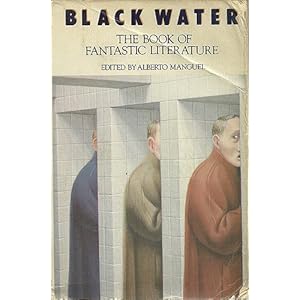
But speaking of short stories, I was reminded of a (very) short story when 'talking' to the writer Vivienne Tuffnell on Twitter, who needed something short and spooky for a class she was teaching. I first read it in the splendid anthology Black Water, which is shamefully out of print (I notice new copies are going for close to 75 quid - I got mine from a charity shop for 50p...!)

Black Water: The Book of Fantastic Literature

It's a huge anthology of creepy, scary stories, from writers both inside and outside the horror genre. The story below is the shortest one in it; indeed one of the shortest stories anywhere. It's also out of copyright so I can reproduce it here - hurrah! - and I think it's fantastic. It's from 1919, for anyone who thinks newfangled 'flash fiction' is actually new.

And it pretty much speaks for itself.


     Climax For A Ghost Story - I.A. Ireland

      "How eerie!" said the girl, advancing cautiously. "--And what a heavy door!" She touched it as she spoke and it suddenly swung to with a click.
      "Good Lord!" said the man. "I don't believe there's a handle inside. Why, you've locked us both in!"
      "Not both of us. Only one of us," said the girl, and before his eyes she passed straight through the door, and vanished.


7/24/2011

In Defence Of Short Stories #11: Dan Holloway


Today's guest blog purports to come from one 'Dan Holloway', although given the sheer scale of literary activity attributed to Dan, I suspect that name is just an alias for a group of say ten or twelve highly talented people working anonymously. How else to explain the following?


    Product Details
  • Dan Holloway wrote one of the best self-published novels I've read: Songs From The Other Side of The Wall (UK | US)
  • More pertinently to this guest blog spot, Dan wrote the short stories and poems in (life) razorblades included (UK | US)
  • He also finds time to be involved in Eight Cuts, editing such works as Penny Goring's The Zoom Zoom (UK | US)
  • And he also wrote The Company of  Fellows, voted in a Blackwells poll their favourite Oxford novel (UK | US). Yes, best ever.
  • And he finds time to read his short stories aloud at such events as Brighton Fringe's Grit Lit, Covent Garden Poetry Cafe's Literature Lounge and Literary Death Match. See here for an example.
  • And more! Dan is publishing a series of episodes of his Black Heart High, the first part of which is behind these here links: UK | US

Dan HollowayI mean c'mon, it's hardly believable that this is all the work of one person, particularly when you take into account the fact 'Dan' has also apparently read every good book ever, and has never once failed to post on an internet forum or message board when the words 'Murakami', 'Oxford comma', or 'self-publishing' have been mentioned. And he is unfailingly enthusiastic, friendly, and genuine with what he posts.

So no, I don't believe in 'Dan Holloway', and was going to reject his In Defence of Short Stories out of hand... but then I read it. Wow. It's called Flash. And you should all read it too.

Take it away, 'Dan'...

Flash

I've been reading James’ defences of short stories for some time now, and I’ve sat at my desk thinking about putting something together, wondering what I could say. It should be easy. I write short stories. Lots of them. And not just short stories but flash fiction too.

That’s it, I thought, before I asked James if I could put something together. Flash fiction. After all, I haven’t seen too many people defend it. It’s still looked upon as a bit of a novelty, a parvenu, not at all the place where an author would have the space to attribute three whole adjectival clauses to a single noun.

The problem is I’ve never really been an apologist. Do. That’s my motto. Don’t think it, live it. And live it again, and keep on living. Just like Katelan said that night when we sat around in button back chairs telling the audience about Lilith, and embracing life so close you choke on it, and her friend Holly, who died in her early twenties but lived more than you or I ever will.

Katelan.

Of course.

It was mid morning. Fuck knows what time o’clock in New York but I called her anyway.

Hey you, she said with all the energy I remembered, and I didn’t feel so bad.
Hey.

So?

So I’m doing this piece about flash fiction.

Yeah?

Yeah, about how cool it is. No, not just that. A defence of it.

A defence of it? she said and I could hear the frown lines. What’s to defend?

Exactly, I said, it seems so obvious.

So obvious you can’t think how to put it, she said, and I just laughed, and there we were laughing down the phone together at how ridiculous it was.

So how come you’re up? I asked.

She told me she’d been on a shoot and I asked her what they’d been shooting and she said she’d spent all day riding the IRT sharing homemade cupcakes with strangers while a friend filmed the thing on his phone and I said that sounded pretty cool and she said yeah it was cool, and then she spent an hour telling me about this guy who was going to propose to his partner only he wasn’t sure and he and Katelan talked it over for so many stops as they ate and her friend filmed and they ate some more and talked some more that he missed his stop and his partner called him and he picked up his phone in the middle of a mouthful and Katelan heard her say fuck you, asshole and the guy laughed and ate more cupcakes and felt so free he rode another ten stops with her while her friend filmed.

I asked her what she was going to do with the shoot and she said her friend was just finishing the film as we spoke and was going to upload it the moment he was done. I asked her if she could send me a link and she said not to worry I was first on the guy’s list when it was ready so I said thanks and she said you still don’t know what to write, do you?

No, I said, and she laughed and I asked her why and she said I’d always been slow on the uptake but not to worry, when I got the point I was always the right one to follow it through. I shrugged and asked her what the piece was called so I could tell people about it. I heard another voice, not hers, a man’s voice and it said, I’m not the one who lived. I’m not the one who lived, I repeated and Katelan’s voice and the man’s voice were laughing at the end of the line and then they weren’t. They weren’t anything. I held the phone to my ear waiting for her to say yeah, or awesome, or goodbye or something but she didn’t, and the next noise was the ping of an incoming e-mail and I held the phone close and mouthed thank you down the line. Thank you, that’s exactly what I needed to say.

7/03/2011

In Defence Of Short Stories #8: Tim C. Taylor

Tim C. Taylor is all over the short story scene at the moment: publishing his own stories such as No More Than Human, which I've mentioned here before; setting up Greyhart Press (which publishes some great sci-fi and horror short stories); and working with people such as Neil Gaiman on books like Fables From The Fountain.

Let's see what such a chap has to say about short stories shall we? 
Product Details

Take it away Tim...

There's never been a better time to explore the universe of short stories, novelettes and novellas.

Here's a short story for you now:

A man walks into a Costa Coffee and orders a cappuccino grande for £1.65…

Okay, not much of a story yet, but we'll come back to this later.

Slip back a century or so, and a fair chunk of literature was first published in short form within popular periodicals, for example the Sherlock Holmes stories and many of Dickens' novels were initially serialised. Since then, short fiction has had a bad time, until now. Sure, there have been pockets of vitality, such as the American pulp magazines of the 30s and 40s, but short fiction has been fighting a rearguard action for a century, finally beaten back to the last redoubts of niche publishers and for-the-love webzines.

This blog post, and the Scattershot Writing website, is part of that defence. Except we are no longer manning the walls, but have sallied forth and are beginning to reclaim ground lost to the novel.

There's never been a better time to explore the universe of short stories, novelettes and novellas.
A man walks into a Costa Coffee and orders a cappuccino grande for £1.65, a mozzarella, tomato and basil Panini for £3.95… 


Perhaps we'd better pause for a working definition, taken from the SF Writers of America. A short story is up to 7,500 words; then we have novelettes up to 17,500 words. Novellas take us to 40,000 when we pass on to the novel.

Never heard of a novelette before? Only dimly aware of novellas? Well, better get used to them as you'll hear a lot more of them more over the coming years.

Of course, there's more to the definition of short fiction than word count. Short stories tell a story: something happens, characters are transformed, readers are transported to other worlds and experience them through other people's perspective.

Writing short fiction requires great discipline and forces hard choices. Authors often limit the attention on one aspect of the story in order to concentrate on another. For example, secondary characters might be given a cursory treatment because the author concentrates the focus of the story on the main character. Short story authors talk of words like an austerity government might talk of dollars: there is a limited supply and each dollar spent must justify its expense. The shorter the story, the harsher the fiscal discipline.

Crafting short fiction well is hard. Successful novelists talk of how much easier novel writing is because they have much more space to write whatever interests them.

Writing a 130,000 word fantasy novel and love the city setting you've built? Why not add another 3,000 words to describe more of your city? Now you can get in that detail you worked out about the Guild of Sewer Sweepers. 'Three thousand words?' says your agent. 'Heck, add another five thousand about your city and maybe we'll get compared to China Mieville.'

If a 130,000 word novel is like a bottomless cup of Americano, experiencing a good short story is like an espresso: not merely a shorter and more intense experience but something palpably different.

Which reminds me; we were writing a short story about coffee earlier…
A man walks into a Costa Coffee and orders a cappuccino grande for £1.65, a mozzarella, tomato and basil Panini for £3.95, whips out his Kindle and browses his favourite authors online before buying a cracking 7,000 word short story for 70p. Half an hour later, the man has eaten, drunk and read his fill. Which of the three do you think he will still think about tomorrow? Which was the cheapest? 
Well, that man was me this morning and the Costa Coffee outlet was on Silver Street, Bedford. The only fabrication was that the short on the Kindle hasn't been published yet (I can make up details like that because this is a story, though I never claimed it was an exciting one!)

My bad short story points to why good short fiction is fighting back. Anthologies and periodicals never quite went away but with eReaders and iPads, and similar technological paraphernalia, as a reader you can bring your library of short fiction with you, organised by category and author. You can even add the authors you like where and whenever you want and at a bargain price. At long last, short stories, novelettes, and novellas can be produced and consumed on a level playing field with novels. And that is why I say:

There's never been a better time to explore the universe of short stories, novelettes and novellas.

6/26/2011

In Defence Of Short Stories #7: Jim Breslin


Before we dive in today, I'd just like to say to any new readers that I'm still on the look out for 'In Defence of Short Story' guest blog posts; I'd particularly be interested in posts covering different aspects of the short story than those so far: maybe discussions of a particularly story, or reflections on reading short stories live to an audience.
But onto the main event - today's guest is Jim Breslin, author of the literary short story collection 'Elephant' (Kindle UK | US | Nook); you can also sample two of the stories in 'We're Not Dog People' (Kindle UK | US). His short stories have been published in Think Journal and Metazen and he is also founder of the West Chester Story Slam. 

For lovers of short stories I can also heartily recommend paying a visit to Jim's blog, where he has set himself the challenge of reading and reviewing the thirty-six short stories long-listed by One Story - some great stories featured, and Jim's comments always make me want to read the stories, or read them again if I've read them before. Oh, and he also Twitters as @jimbrez

Take it away Jim...

Savoring the Short Story

The short story is the greatest of all art forms, but each one should be handled with the greatest of care. A short story is meant to be savored in quiet, read carefully in one sitting. It’s important not to rush through stories as though they are chapters of a novel. One story at a time. Take a break and refill your wine glass. Reflect. Contemplate. A short story provides a glimpse into every day life. They are often sketches of smaller moments, though some portray lengthier spans, even generations. But the ones I believe work best cover the smallest of moments, such as tracing the stretch marks on a wife's legs or eating 
crusty rolls in the back of a bakery while in mourning.
In the digital age we have so much information pecking at our brain. We are trained to read shorter bits of information. We spend our days scanning blurbs on the internet, tweets and Facebook posts. Last summer, we asked my 16-year-old son how his summer reading assignments were going. His response? “I don’t have time to read. I have to keep on top of my text messages.” This is a statement of our times.

Product DetailsWe have moved from the information age to the digital age. Shorter is better. And you want to talk short form? The first place I was published was in David Pogue’s anthology The World According to
Twitter. I believe the short story is making a comeback because. Compared to reading one-line news blurbs on the Huffpo or Drudge, Facebook posts, text messages and tweets, the short story is the new novel. The world can be, should be, held at bay for fifteen or twenty minutes to escape in fiction, to be swept away by a tight and complete story.

Product DetailsFor those that say they prefer a novel, I would like to suggest a new approach. Keep a collection of short stories on your nightstand. Read one story a night before bed, then flip off the light and mull the story over. Think of the symbolism and the themes. What the author was trying to stay? Does it resonate? Swish it around as if at a wine tasting. Smell the oak and the tannins? I think this analogy is very appropriate actually. Although I’m not a wine connoisseur, I can recall five or six wines that, for some reason, were perfect for my taste buds in that moment. A great short story also hits you in the moment. I first read Raymond Carver’s “A Small Good Thing,” while sitting in the back of a van with my brothers and sisters. Nearly thirty years later, I still vividly recall finishing the story, placing the book on my lap, and looking out the window. I didn’t want anyone catching me in tears after reading something so sad and beautiful.
Not many people forget reading Flannery O’Connor’s “Good Country People,” or the ending of James Joyce’s “The Dead.” In recent years, I felt my heart stop for a moment at the end of Donald Ray Pollock’s
“Real Life,” and I gasped at Boomer Pinche’s “Bethlehem is Full.” Reading the short story is like pursuing the perfect glass of wine. It can be enjoyed in one sitting, it doesn’t take hours, days or weeks to
get through, yet it resonates within you for a long time. And for this I am grateful.
 

6/03/2011

In Defence Of Short Stories #4: Iain Rowan


Product DetailsThis week's guest blog comes courtesy of Iain Rowan, who writes crime and horror short stories, amongst others. One of his stories, Lilies, has been featured in the Mammoth Best Of Horror Anthologies edited by Stephen Jones. Those of you with any interest in literate and intelligent weird fiction will already know what a big deal this is; to those who don't, I will just say that unlike most things that say "Best Of" on them, Stephen Jones anthologies actually are. And Lilies, also available as a standalone e-book, fully justifies its inclusion.


You'd expect such an author to write a great blog post defending short stories wouldn't you? You betcha.

Take it away Iain...


There are two ways to defend the short story, an easy way and a harder way.
The easy way is this. I say: read Chekhov and Carver, Joyce and  Kafka, Gogol and Murakami. Or I say: read Aickman and Machen, Ballard and Gilman, Bradbury and King. Or better still, read all of them, and more.
Job done, time for tea. 
That makes a dull blog post though, so I will try the harder way, and explain why I love reading and writing short fiction.  There are people who would never choose to read a short story, who don’t see the point of short stories, who don’t like short stories – you may be friends with these people, you may work with them, or you may see them on the street. Don’t be frightened by them – they mean no harm, but they do need your help, so please give generously. Anthologies, collections, whatever you can spare.
You may be one of these people. Don’t feel bad. Well, feel a little bad, because you are weird and more than a little wrong. But you can fight this thing. We’re with you. Well, a few apprehensive steps to the side, because of the whole weirdness thing, but with you in spirit.
I want to start with my defence of short stories by pointing out a way in which novels are better than them. With a good novel, you can lose yourself for hours, days, in a world of someone else’s imagination, that total immersion when the world of the book starts to feel as real as the one that you live in. You don’t get that with short stories. But that’s not a failing, because that’s not what they do. 
Short stories do something different. They are not little novels. They are not novels with lots of words left out. You don’t get immersion, you get a glass of icy water thrown in your face.  Bear with me, it’s more attractive than it sounds. While one of the charms of the novel is the room for digression and expansion, the beauty of the short story is the merciless concision it imposes. The short story ditches all that is dressing, it strips back all that is luxury, and it pares everything down to the single purpose of the story that is being told. It excludes most things, but in doing so attempts to capture one really important thing, whether that is an essential, startling revelation about what it means to be human, or scaring the living shit out of the reader when they turn the lights out later that night. 
One of the reasons why I think some genres work so well in the short form is that they can be read at one sitting. That kind of immersion in the story works well where the atmosphere that the writer builds is critical to the genre, and that’s why for me there will never be a novel of the supernatural that is as great as the best short stories.
Not only can short stories be read at one sitting, but they can be written in one too. Not all of my own stories have been written in this way (for that I’d need a better attention sp—hey look, a pony) but I like the continuity of tone and thought that you get writing the entire piece in one go, or over just a couple of sessions.
I have seen advice to writers which suggests starting with short stories, as if they are children’s bikes that you wobble along on until you are big enough and brave enough to take the stabilisers off and ride your way to a fat 120,000 word novel with as many characters as pages. This is bad advice. If you want to write a novel, you should write a novel. If you want to write a short story though, write a short story.  
Precision, concision, graceful economy. A novel can bring the cumulative weight of the development of plot and character to create an emotional response in the reader, but a good short story has to have the magic to do so in a instant.  One line, one paragraph, one moment of terror or surprise, beauty or revelation. There’s skill, and craft, and art in that.
The novel is an album (some novels, like some albums, are sprawling three-disc concept albums with gatefold sleeves). The short story is the killer three minute single. It starts, hooks you, smacks you around the face, and then when it’s just got started, it stops, leaving you wanting more. But once you’ve heard it, it’s there in your head for years. 
So there you have it. My defence of the short story and a tortured analogy which, possibly for the first time, allows the direct comparison of Justin Bieber to Ernest Hemingway. Thanks for reading it.
Product Details 
Lilies, mentioned above, is available on Amazon (UK | US).
Nowhere To Go is a collection of Iain’s previously published short crime fiction. (Amazon UK | US | Smashwords). Read more at his website.


5/20/2011

In Defence Of Short Stories #2: Neil Schiller


. 

Well, I think it's safe to say that last weeks inaugural 'In Defence of Short Stories' was a success - it attracted way more views than I've had on this blog before (admittedly, not a hard record to break) and I've had lots of interest from other authors wanting to pitch in since then, which is great. Although I deliberately started with Alain and Neil (of whom more in a minute) as I knew they'd write something good to kick things off, I knew that after that I wanted to find some writers who were new to me.


Product DetailsBut onto this week's contributor, the fabulous Neil Schiller. Regular readers of this blog [insert your own 'both of them' joke here] will know Neil's name - his book of short stories 'Oblivious' was the first indie ebook I bought, and boy did it set the bar high. Put it this way, in his blurb Neil compared himself to Raymond Carver, and after I'd finished his book I didn't think he was a twat for doing so. High praise. 


Oblivious is available on Kindle (UK & US) as well as paperback. Please give it a whirl, particularly as it looks like Neil will be sleeping on the sofa for the next few days...


Take it away Neil:


My other half doesn’t like short stories. She tells me they end too abruptly, just as she’s getting into them. Don’t tell her, because it’s more hassle than it’s worth, but I completely disagree. My favourite books all share one thing in common: an economy of style. Very rarely do I read anything that looks like it will be over five hundred pages, because I immediately think “oh no, another Umberto Eco”, the writer who by his own admission just can’t help himself and has to follow every single tangent that his mind suggests to him.

Short stories, to me, are often more powerful than novels. Because they have a focus that can really deliver. To take an analogy (probably a lame one), it’s great to wander about in the sunshine, of course, but it’s only if I concentrate that light via a magnifying glass that I can set fire to shit. That’s obviously my inner pyromaniac talking. I’ve just spent the best part of a decade writing short stories because I was experimenting with the idea of looking at things intensely. It didn’t matter that I was representing only moments in a character’s life because I could (hopefully) make those moments resonate without having to worry about narrative continuity and plot twists. And you have to give the reader some credit. He or she is not a moron. If you do it right they’re already filling in the gaps for you, the backstory, the future, mopping up the bits that you’ve left spilling off the page.

As a reader, I love doing just that. One of my favourite short stories is by Richard Brautigan. It’s two sentences long. I won’t quote it because I don’t want to breach copyright, but it is essentially one image – that of a woman being led away by the police because she just couldn’t stand anymore living in a small apartment, in the middle of summer, with a man learning to play the violin. I know the rest, Brautigan doesn’t have to tell me.

The best short stories are evocative and demand more of you as a reader than an epic that spells out every single idea on your behalf. Not everybody likes those demands, and that’s fair enough. But I do. They make me feel like more of a participant in the process. The writer is letting me forge my own meanings, and I think that’s a satisfying mental exercise.

To switch to poetry for a second, the classic poem covered in the first year on just about every literature degree course is ‘The Red Wheelbarrow’ by William Carlos Williams. I’m sure it’s in the syllabus to deliberately challenge young students. What does it mean? Is it poetry? Nothing is resolved. We’re told a wheelbarrow and some chickens are all that matters. What is it all about? It always divides opinion. Personally, I love the poem. I love Haiku, I love single images or hypothetical snatches of hyperbole that challenge you to make of them what you will. Don’t give me an answer, I don’t want your answers, they will most likely be subjective nonsense anyway. Give me a pinprick instead, a trigger to my subconscious that can then lead me off on a path of my own.

At the end of the day, isn’t that what art is supposed to do? You’re not there to receive wisdom, you’re there to think about things for yourself. A great short story writer like Raymond Carver, like Chekhov, like Brautigan, always reminds me that this is the case. I’ll keep coming back to them again and again because without them my imagination would probably just shrivel up and die.

Going back to my missus – sorry love, you’re entitled to your opinion, of course you are, but it’s a shame you’re wrong. (Seriously, don’t tell her I just said that, I don’t like sleeping on the couch…)


Oh, and just to show that two can play at this guest blogging game, please check out this piece I've done for the fabulous and infamous Andre Jute's blog. It's about DH Lawrence and his poem The Mosquito.  It's kind of about me too, but since nearly all of DH Lawrence's literary criticism was as much about himself as who he was writing about I don't feel too guilty.