You can read it here.
"The triumph of Everington’s first novel is that, while hinting at lofty literary precedents, it cumulatively takes on an unsettling voice all of its own." The Guardian
11/12/2022
Night Time Logic: Interview with Cemetery Dance
12/21/2020
NY Ghost Story Festival Night Five
Christmas is traditionally a time for ghost stories, and I had great fun taking part in the digital New York Ghost Story Festival last night; if you missed it you can find a recording of the whole event here.
It was really nice to meet—albeit virtually—the host Daniel Braum, whose fiction I admire a lot, as well as the other guests C.C. Adams, Liliana Carstea, John Langan, and Farah Rose Smith. There was lots of really interesting points made about the ghost story and hauntings real and imaginary in fiction, so do give the whole thing a listen. (And I must thank CC for his kind words about Trying To Be So Quiet.)
Each of us also did a reading from a ghost story we admired: my pick was 'Lilies' by Iain Rowan. Not a traditional, Jamesian ghost story perhaps, but for me it's a beautifully written story about one of the key themes of the ghost story: the unknowability of the dead.
And on that note: happy Christmas to all readers of this blog...
11/25/2020
New York Ghost Story Festival
I'm pleased to say I'll be one of the authors (virtually) attending the New York Ghost Story Festival, which is organised by author and all round good-egg Daniel Braum. The idea is authors will be reading their favourite ghostly story by someone else rather than their own work.
I've already picked the story I'll be reading, and I'll be doing so on the fifth night of the festival: 20th December at 4pm EST (which I think is 9pm UK time...) On the same night as me they'll also be readings from CC Adams, Liliana Carstea, John Langan & Farah Rose Smith.
More details about the event can be found here. I hope you'll join me for some spooky fun.
8/21/2020
Recommendation: Underworld Dreams by Daniel Braum
I was honoured to advance read Daniel Braum’s forthcoming new collection, Underworld Dreams, which is now available to preorder:
2/15/2018
Recommendation: The Wish Mechanics by Daniel Braum
So I bought The Wish Mechanics as it was his latest collection, although upon reading the introduction I found out that the stories within are generally contemporaneous with those in his other collection, The Night Marchers. The tales in that volume are apparently more rooted in horror tropes and aesthetics; the stories in The Wish Mechanics are a more varied and eclectic bunch.
It starts with the wonderfully titled 'How to Make Love and Not Turn to Stone', a frankly brilliant story about a couple who live above a beach on which real-life basilisks roam. It's a beautifully handled concept, powering a narrative concerned not so much with the supernatural creatures and their ability to petrify, but with relationships and what we might risk by getting involved with another person. With the various ways our hearts can be hardened. As is common with many of the best stories here, the supernatural element is at once 'real' within the world of the story and metaphorical, not so much a 'symbol' as a concrete representation of ideas the author wants to evoke.
'How to Make Love...' pairs nicely with the final story in The Wish Mechanics, 'This Is The Sound Of Your Dreams Dying'. This is another tale about relationships, both how they begin and how they end. The uncanny element starts as a backdrop for the characters' emotions and dilemmas, but moves centre-stage with some powerfully creepy scenes.
In between these two pieces there are plenty of other gems. 'An American Ghost In Zurich', as well as having (again) a brilliant title, is another immensely impressive story. It is based around a particle accelerator similar to the Large Hadron Collider, and the scientific concepts it plays with—alternative worlds, retro-causation, quantum entanglement—are used to give it feeling of strangeness, of almost Borgesian other-worldliness, that's as strong & powerful as that which traditional genre tropes can evoke. It gains bonus points from me for featuring alternative-dimension songs from a band I love, School of Seven Bells.
Elsewhere, 'Tea in the Sahara' is a more old-fashioned styled story about wishes and fate and three sisters; 'The Canopy Crawlers' a 'straight sci-fi' story full of invention (which shows Braum can sure as hell write action, too), and 'The Water Dragon' takes us back to strange fiction again. There's further sci-fi of a dystopian nature in the title story, and the end of the world (literal or otherwise) in another favourite of mine, 'The Truth About Planet X'. Plus there's plenty of other fine stories to savour, too.
So, overall The Wish Mechanics is a varied, eclectic, accomplished set of short stories, with a number of genuine classics within its pages. Looks like I'll be buying The Night Marchers too then.
The Wish Mechanics (UK | US)
1/18/2018
The Outer Dark: A Strange & Darksome Night
The Lovecraft Bar, New York City.
Julia Rust. David Surface. Daniel Baum. Inna Effress.
Four fantastic writers get together for a night of readings from Nightscript III and to discuss weird fiction in general.
Bet you wish you could have been there and heard that, huh?
Well, now you can (hear it at least) thanks to The Outer Dark podcast, you can. The show is hosted by Scott Nicolay, joined by Daniel Baum and Nightscript editor C.M. Mueller. You can listen it now on This Is Horror:
The Outer Dark #27: Nightscript III
11/24/2017
Daniel Braum Nightscript III Interview
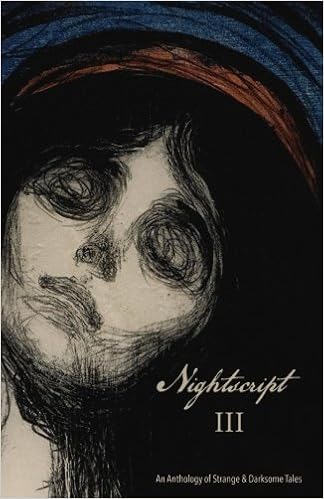
My story 'The Affair' recently appeared in Nightscript III, along with stories by many talented authors of the weird and strange. One of them is Daniel Braum, who got in touch and suggested we conduct a joint interview with each other about our respective stories. (Daniel has also organised a night of readings from Nightscript III at the Lovecraft Bar, New York, featuring authors David Surface, Julia Rust & Inna Effress.)Tomorrow, I'll be answering questions on his site about 'The Affair'; below you can see his answers to my questions about his Nightscript tale, the wonderfully creepy 'Palankar'. (I'd never read any of Braum's work before, but 'Palankar' single-handedly convinced me that I needed to rectify that; since then I discovered his story 'A Girl's Guide' which you can and should read here. I'll be checking out his other stories pronto.)
So without further ado...
JAMES: So firstly I wanted to ask you what kind of writer you consider yourself and what kind of story you think 'Palankar' is: do you think of it as a ‘weird tale’, an heir of Aickman’s ‘strange stories’, just plain horror? Or do you think this micro classification of literature is pedantic noise?
DANIEL: I don’t think the micro-classifications are pedantic. I can see so many ways why they don’t matter and for a very long time I knew little of them. Lately I’ve found they can be helpful in terms of my education and efforts to bring stories to readers.
As a writer relatively new to the larger category known as weird fiction, in the course of my recent journey of education I’ve been thinking a lot about “what makes a kind of story that kind of story” for many reasons.
I’ve found one of the more exciting things about ‘weird tales’ and strange stories and horror is how often and how well these stories co-exists with other genres within a single given story. I recognize that any classification varies from reader to reader or author to author. Now that 'Palankar' has been published in Nightscript 3 I feel more confident calling the story a ‘weird tale’ or a strange stories in the spirit of Robert Aickman’s work. I could easily go down a rabbit hole of a discussion entirely about classification. Are weird tales a subset of horror? Are strange tales a subset of weird fiction? Perhaps any classification is an artificial restraint. What I do know is that stories of the kind that Robert Aickman wrote and that appear in Nightscript 3 could easily classify as weird fiction, fantasy, science fiction and or horror and or simultaneously exist alongside any of these labels, which is one of the many reasons these kinds of stories excite me. Even now, knowing a lot more about craft and genre, I still find it helpful to not think about genre when writing- at least not when writing a first draft or the “creation” stage of a story. I feel this helps avoid placing limits on a story and avoids caging it into a notion of what it can or can not be.
So what kind of a story do I think 'Palankar' is?
When I set forth to write 'Palankar' I was attempting to dramatize a notion. I started with this goal not a genre in mind. I wanted to write a story that illustrated a concept or observation on my mind—the notion was that we as humans can only go so far in trying to help or rescue others, particularly those we love, or risk the danger of “drowning” with whom we are trying to help. Thinking about genre didn’t come until very, very late in my process. Often the last part of my creative process is getting peer feedback. When I finally showed the story to others was the first discussion of just what kind of a story it was and what, if any genre it might fit into. Thinking about genre at that time helped me have confidence in my ending.
Right around the time of getting my peer feedback (late 2015) I had recently heard Peter Straub talk about Robert Aickman. Peter Straub’s views on how a Robert Aickman story operates was my gateway to both Aickman’s work and to weird fiction in general. This experience made me realize that my work had a classification or a home after a long time of feeling like it never quite squarely fit as science fiction, fantasy, or horror. The short story 'The Swords' was the story Peter Straub used to demonstrate “an Aickman story”. The story was heavily on my mind during the time I was revising 'Palankar'. I spent a lot of time thinking a lot about why the ending of 'The Swords' works and what kind of story operates in these ways.
Learning that a story not only could be “ambigious” but that there was a whole genre and movement that worked with this concept was exciting and eye opening and provided me with some of the confidence that I could (or in general one could) end a story on a certain point of ambiguity.
JAMES: I thought the ending of your story was very well done: it took the point of view of the brother to the end of his character arc but left so much untold and ambiguous as well. Did you always plan to end the story with unanswered (and perhaps unanswerable) questions?
DANIEL: I didn’t plan it that way. Early on in drafting it I knew the end point of the story would be where my character would have to make a choice—a choice to cross over to a point of danger in his quest to help a loved one.
From what I’ve learned about Robert Aickman it appears that the creation of his stories is an organic process and closely tied to his dreams. For me it is the product of thought and decisions about the characters and a lot of drafting
JAMES: I’m a big fan of ambiguous endings myself (if done right) but do you worry some readers will find them frustrating?
DANIEL: I think the reason I do not worry is because I accept it as cold, hard fact that many (if not most) readers are categorically frustrated with and do not prefer ambiguous endings. Perhaps this is why Aickman is not widely appreciated?
I think this is where classification might come in to play. Classification helps match up readers with kinds of stories they prefer. I think the ending to the movie It Follows is a brilliant ending to a brilliant movie. I would call it a cinematic ‘strange tale’ in the spirit of Robert Aickman. The movie’s ambiguous elements and ending frustrated many viewers. Viewers I spoke with preferred that stories “wrap up” or operate with defined logic and rules as opposed to the “night time logic” the felt but not consciously-known aspect element of Aickman stories, some weird fiction, and certainly the movie It Follows functions on.
I think the ambiguity in your story is a wonderful example of this. It places emphasis on the emotional reality and reactions of the characters and away from overcoming or defeating any antagonist or monster or any defined phenomenon. Returning to the notion of classification, this is one reason the distinction of the strange tale being a type of story all of its own, is both warranted and useful at times.
JAMES: Since both of our stories deal with doubles and duality, it feels apt that our questions should echo each other as well. So what is it about the theme of the double and the twin that appealed to you as a writer? And have you written other stories based on the same trope?
DANIEL: While I wasn’t consciously thinking of doubles or twins when drafting 'Palankar' the notion of two of the same thing or person is fascinating to me. I think there is a wealth of opportunity to show and explore the differences of and importance of choice and choices made. And the notion of the “evil twin” while just being plain fun also lends itself to explore these things. Perhaps the notion of duality is a hallmark or at least familiar ground for weird fiction. In my short stories 'Sumo 21', 'Emperor of Mist' and 'Between Our Earth and Their Moon' ( forthcoming in the anthology Would But Time Await) all explore the consequeneces of meeting / interacting with/ and knowing about one’s otherworldly “double”.
So while I was not consciously thinking of it while drafting 'Palankar' it is something I think about so it makes sense it manifested in the story. Maybe there’s a bit of the Aickman’s subconscious method in me yet!