Showing posts with label Gary Fry. Show all posts

4/28/2019

Yesterday

Trying To Be So Quiet & Other Hauntings was published yesterday by The Sinister Horror Company. The title story was originally publishing as a limited edition novella; the new volume contains two extra stories: 'The Second Wish' and 'Damage'. They are all stories on the theme of the supernatural as a manifestation of grief and loss.

Some of the original reviews are linked below, if you'd like to know more...

"If you like your horror quiet, stealthy, and throat-achingly sad, this one is for you." Tracy Fahey

"...a deeply moving story, emotionally charged,with a powerful and rich narrative, it is an exemplary example of ability for quiet horror to chill a reader to the core." 
Gingernuts Of Horror.


"This hugely chilling and evocative story, mixing lyrical language and lost love, is told with great psychological acuity." 
Horror Blog UK


"A small, quiet, poignant novella about grief and significance... No noise, no fuss, just good, honest writing about the things that matter. Recommended." Gary McMahon


"I really enjoyed this short, condensed novelette, which is packed full of bitterness and yearning, defeatism and aspiration. It’s what loss actually feels like... It’s a fine piece of work." Gary Fry


"I literally had goosebumps when I finished reading"

Anthony Watson, Dark Musings

"A must read, wonderful.", Yvonne Davies, Terror Tree


 Trying To Be So Quiet.

7/30/2018

Recommendation: Black Shuck Shadows Double Bill

I recently had the pleasure of reading two volumes from the Black Shuck Shadows line: The Death Of Boys by Gary Fry and Broken On The Inside by Phil Sloman. Each book in this series features 3-6 stories from a single author, all based loosely around a theme.


The Death Of Boys was a fun collection of stories. I've read a lot of Fry's fiction by now, and I think it's fair to say that much of it consciously & deliberately 'announces' its thematic concerns—I don't mean this as a criticism, it's his style. But the stories here felt a lot more like Fry was just playing with horror tropes, having fun, writing his equivalent of a horror B-movie. (Again, not a criticism.) Which isn't to say that thematic concerns don't crop up—it's probably no surprise from the title that these tales focus on boyhood, parenthood, growing up, adulthood, and death. 'Zappers' is the story of a young boy apparently hit by lightning yet seeming to suffer no ill-effects (initially). 'Cat-B' concerns that most boyish/masculine obsession, cars, and seems to be Fry's version of Stephen King's 'bad car' stories Christine and From A Buick 8. As good as these two preceding stories were, it's the final tale, 'The House Of The Rising Son', that really impressed me. Again, it plays with some relatively standard horror tropes to begin with, but builds to something that's both nightmarish and thematically apt—indeed it seems to both sum up and interrogate the themes Fry has been exploring for the entire collection. Exhilarating stuff.


Phil Sloman's Broken On The Inside is a collection of stories based around the theme of mental health, or lack thereof, giving us five tales of people damaged, at odds with reality, hunted, haunted or just struggling to cope. Unfortunately, I can't say too much about one of the stories here, 'Virtually Famous'—not because it's not good (it's the joint-best here, IMO) but because it was first published in Imposter Syndrome so I'm biased. I've no reason to be biased about the rest of the stories though, and I can say that they are also bloody good. Sloman switches effortlessly between surreal black comedy—see especially 'Discomfort Food'—and more ambiguous, serious work. Both 'Virtually Famous' and my other favourite here, the title story, mix the psychological with a sort of near-future techno-horror, to produce narratives where the distinction between what is real and imagined blurs and fractures. 'Broken On The Inside' is a the story that has a touch of Cronenberg about it, a touch of Black Mirror about it, of Roald Dahl's adult stories and old-school sci-fi. It's well worth a read.

The Death Of Boys (UK | US)
Broken On The Inside (UK | US)

11/30/2016

Recommendation: The Doom That Came To Whitby Town by Gary Fry

Whitby, 2019
The Doom That Came To Whitby Town is the swan song from the much respected publisher, Gray Friar Press, owned by Gary Fry. This parting gift is a novella from Fry himself, in which something ancient and monstrous is uncovered after a cliff fall on the coast near Whitby. The 'something' is spirited away and hidden by the town's authorities, but that doesn't stop its malign influence from spreading...

As might be gathered, this novella is firmly rooted in Lovecraftian tropes, although here they are not treated with the unnecessary, cloying reverence of most modern mythos fiction. Indeed, one gets the sense that Fry was having a blast writing this one, gleefully destroying both his own home town and his protagonist's settled bachorlohood as the story progresses. Whereas much of Fry's work (of which I'm a big admirer) uses horror to explore serious contemporary concerns, Doom is faster paced, lighter on its feet. Most importantly, in places it is genuinely creepy and unsettling.

In part the book works so well because of its use of setting - I was lucky enough to visit Whitby earlier in the year (and to meet Fry himself) and instantly recognised Doom's depiction of narrow streets and narrower alleys, steep hills, deserted pubs, sea frets and maurading Herring Gulls. Much of the story is set in the off season when all the tourists have left, making it easier to visualise in the mind's eye the things Fry only hints at: mishappen beings shambling the misty streets late at night, the locals begining to hide themselves away from prying eyes. There are mysterious deaths, strange pentagrams, visions of the cosmic on the beach (a shout out to Fry's own Emergence, perhaps), and an unhealthy number of things centred around the number five. Even the bastard seagulls are not untainted by what is happening in Whitby town...

A fine piece of work, compelling and entertainng in equal measure.

The Doom That Came To Whitby Town (UK | US)

5/12/2016

"What loss actually feels like... "

Many thanks to the author Gary Fry for his advance review of Trying To Be So Quiet which is out very soon. Gary's an author whose work I enjoy and admire very much, so I was very pleased (not to mention surprised) that he has such good things to say about it:

 "I really enjoyed this short, condensed novelette, which is packed full of bitterness and yearning, defeatism and aspiration. It’s what loss actually feels like... It’s a fine piece of work."


You can read the whole review here (and while you're there, do yourself a favour and buy one of Fry's books too). Trying To Be So Quiet is available to preorder from Boo Books now.

3/07/2016

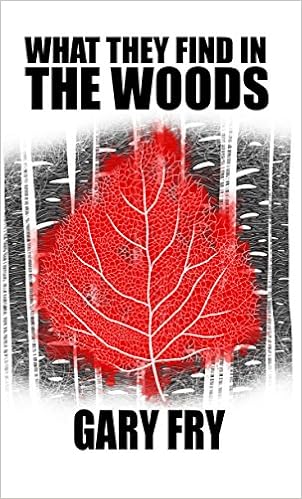
Recommendation: What They Find In The Woods by Gary Fry

Gary Fry's latest novella is released by Dark Minds Press today. Jammy sod that I am, I had the pleasure of reading What They Find In The Woods before its release. I've always liked Fry's work, so it wasn't hard to write some fulsome praise for a cover blurb; what I sent to Dark Minds after reading it was:

“Gary Fry’s What They Find In The Woods is a compelling, erudite and genuinely scary tale that combines deep-rooted folk horror with contemporary concerns. Subtle, clever, yet terrifying in its implications, it’s Fry at the top of his game. It might just be his best work yet.”
But here's a thing. Since writing those words, it's come to my attention that not everything in What They Find In The Woods is necessarily strictly fictional. Gary has posed a number of items on his Facebook page where the central character of the story, Donald Deere, is referenced in academic text books (Gary Fry is an academic himself) about working-class folklore and myths. He's also posted this video, about the story and some of the characters–should that be 'characters'?– in it. Make of it what you will.

It's all slightly unsettling, particularly coming after I'd read the story itself–it's like reality has retrofitted itself to Fry's creation, not the other way around. Odd. (I've had my own brush with fictional worlds and reality seeming to coexist, as those who've read the afterword to The Shelter and this post will know.)

Anyway, the novella is very good and you should buy it. Definitely. It's just... I'm not normally affected by these things, you know, but the stuff Gary has posted is very odd. Definitely buy it. But yeah... odd.

What They Find In The Woods (UK | US)

5/22/2015

Recommendation: Emergence by Gary Fry

A quick post about Gary Fry's novella Emergence which I suspect readers of this blog will like as much as me. Emergence features two central characters, widower Jack and his grandson Paul, come to stay with him at the seaside. Jack's house is isolated from the nearby town, and the story is solely focused on the two of them and the relationship between them, which is deftly and subtly drawn. The central dynamic between Jack and Paul is nicely summed up in the opening scene, where Jack is reading a story to Paul... and trying to ignore doubts about his own failing faculties as he does so.

The theme of communication, and of its breakdown, is very much at the heart of the novella. The supernatural element comes when Paul and Jack encounter strange alien geometries sculpted from the sand on the beach. The shapes are washed away by the tide; if they are an attempt to communicate they are a failure. The things Paul and Jack find on the beach get progressively more sinister and disturbing, whilst still never losing that alien sense of otherness. Neither the characters or us fully comprehend just what they are dealing with, and whether the beings creating the shapes are actually malicious or just totally resistant to human comprehension. The threat posed by them is real either way, and the sense of dread mounts expertly as the novella progresses.

It's yet another example of Fry's clever retooling of Lovecraftian and Blackwoodian (yes that is a word) tropes for the modern world. This isn't just because Emergence is set in contemporary Yorkshire, but because the themes Fry explores in his work feel contemporary too: dementia, cross-generational relationships, even the internet and how it both connects and isolates.

Emergence is a quick and fast-paced work of horror, but also has enough intellectual meat to keep you mulling it over in your head long after you've finished it. Recommended.

5/08/2015

The Outsiders

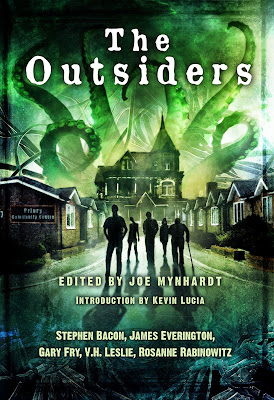
Very pleased to say The Outsiders, a shared world Lovecraftian anthology from Crystal Lake Publishing is out today. It features my story Impossible Colours as well as stories by Stephen Bacon, Gary Fry, V.H. Leslie and Rosanne Rabinowitz plus an introduction by Kevin Lucia. It's an absolute privilege to be published alongside such great authors and being in a book from the fantastic Crystal Lake Publishing is just the icing on the cake.

You can read the blurb below, as well as quotes from each author, including me, about their story.

The Outsiders is available in paperback (UK | US) and ebook (UK | US)


Inside Priory awaits a lot more than meets the eye. The people might seem friendly, but only because their enigmatic leader Charles Erich accepts nothing less.

The cottages within this gated community seem simple enough, and even though what lurks beneath them is more ancient than mankind itself, can anything be more evil than the people worshipping it?

If you dare follow this UK invasion of five prime authors as they each tell their own story of the people living behind Priory's steel gates and high walls, you'll quickly find yourself an outsider, as well.

Stephen Bacon – James Everington – Gary Fry –
V.H. Leslie – Rosanne Rabinowitz

The Priory. A community of one mind and purpose. A place of order, commitment, peace, and service. A perfect world, building on mind shattering secrets from beyond the pale. Enter…if you dare.

“As I wrote the story, I drew on my experience of returning to places where I grew up as an outsider, the 'home town' that was never home – an experience that many people share.” – Rosanne Rabinowitz

“I wanted to take this idea of digging deeper quite literally and write about not only the mysterious and potentially dangerous things the earth conceals, but the often beautiful things it relinquishes.” – V.H. Leslie

“Joe's (the editor's) notion of a gated community filled with various reclusive go-getters fired my imagination, coming as it did during a spell of unprecedentedly terrible activity during a perpetual interest of mine, the darker reaches of the UK economy, all its social strata and clench-palmed denizens. The secrecy and exclusivity of such an enclosed venue struck me as an able symbol for the nefarious activities of many folk involved in the national conspiracy of theft and concealment which characterised the credit crunch.” – Gary Fry

“Lovecraft’s racism (at least as it manifests itself in his fiction) has always seemed to me to be psychological as much as political or overtly fascist. The word ‘xenophobia’ (a rejected title for ‘Impossible Colours’) appropriately describes his unease towards all outsiders, not just those of different coloured skin. Indeed some of his best fiction is driven precisely by the horror of being overrun, of being subsumed by ‘the others.’” – James Everington

12/02/2013

Recommendation: Lurker - Gary Fry

Gary Fry’s new novella from Darkfuse is called Lurker and it’s a typically twisted and multi-faceted tale. It has a simple horror story set up: after a family tragedy, Meg and her husband move to the Yorkshire coast (obviously they’d never read Fry’s The Respectable Face of Tyranny else they would have known this was a bad idea). At a loose end whilst her husband travels back to the city for his job, Meg explores the local landscape and history, particularly that concerning an abandoned mine. She reads stories in the paper about a tourist who has gone missing, and another tourist turns up claiming to be lost one night at Meg's home. And then there’s the hand-prints all over the white wall of her cottage of a morning, and the disturbing dreams, and...

As you can tell, Fry is spinning a lot of plates in Lurker, but you never sense one begin to wobble. The supernatural elements of the tale are nicely dovetailed with concerns about predatory capitalism throughout the ages, and with the state of Meg’s marriage.

All the while the reader is wondering just how much of Meg’s suspicions are real and how much the product of the grief she has suffered. Ultimately it's a story about how our perceptions might be distorted, or made clearer, by loss. Told in tight, clear prose, and with  some beguilingly creepy images (those concerning hands and hand-prints especially freaked me out) this is another fine tale from Fry. 

Lurker (UK | US)