Buy Incarnate here.
"The triumph of Everington’s first novel is that, while hinting at lofty literary precedents, it cumulatively takes on an unsettling voice all of its own." The Guardian
3/05/2026
Recommendation: Incarnate by Ramsey Campbell
6/21/2025
Repost: The Book That Made Me
An online conversation with the ace Ben Unsworth about Ramsey Campbell's new novel An Echo Of Children made me remember this old piece that I wrote for The Ginger Nuts Of Horror in 2014. GNOH site has moved sites since then and despite searching it and the archive I couldn't find this piece, so I thought I'd repost it here. I've not made any changes to what the 2014-me wrote so if you spot any typos or inelegances blame him not me.
The Book That Made Me: James Everington on Ramsey Campbell's 'Dark Feasts'
By this age I'd already discovered Stephen King on my dad's bookshelves, so I thought I knew what horror was. I'd already read some crappy genre stuff as well, so I probably wasn't expecting anything much above the level of being pleasantly grossed out when I bought a book with a picture of a women eating pickled onions from a jar with an eyeball floating in it...
Dark Feasts by Ramsey Campbell. A bargain at 50p (or five Dalek rides, if you prefer). And the book that taught me that horror fiction was far richer and exciting than I'd previously believed.
Visiting the second-hand bookshop was always the last thing we did for the day, because it was near the car park. We legged it through the inevitable August rain to the car, and a few minutes after purchasing Dark Feast I was reading the first stories in the back seat as we drove home.
Dark Feasts is a chronological 'best of' Campbell's short story work; as I remember I was only partially impressed by the first story, The Room in the Castle, which is from Campbell's earliest years when he was trying to write in self-consciously 'Lovecraftian' manner. Even as ill-read as I was back then, I found it a bit derivative.
But the second story... now that was a different matter entirely.
Cold Print is still heavily influenced by Lovecraft in terms of its plot, but its setting is contemporary Liverpool and now the voice of the story is all Campbell's own. And what a voice it is: one of the most distinctive in modern horror, a prose-style so supple that it seems to sing even as it hints at horrors only briefly seen. Up until reading Campbell I'd been under the impression that genre books focussed on story, and that 'fancy writing' was reserved for the kind of books we did at school (look I was fifteen, okay?) What Dark Feasts taught me was how misguided that view was; Campbell's horror works because of his prose, his extraordinary ability to conjure up a disturbing image in just a couple of sentences. His characters merely glimpse the phantoms and bogeymen in these stories, rather than seeing them straight on, leaving them (and us) unsure of exactly what's happening and how real it was.
The rest of the book is even better: Dark Feasts really does contain some of the best horror stories ever written: The End Of A Summer's Day, The Man In The Underpass, The Companion... These stories and others made me aware something else as well: that the best horror is often in the form of the short story.
Trying to recall the experience of reading Ramsey Campbell for the first time is tricky, as I've read his work so often since then. For years, because I could only afford to buy books for my university course, Dark Feasts was the only book I had by him and I read the stories it contained over and over again. In reality there was probably no sudden epiphany; it's more likely that what I learnt from Dark Feasts gradually revealed itself to me, and started to influence the stories I was writing.
And that first story? I even learnt something from that, now that I look back. I learnt that when you're starting out as a writer it's okay to explore your influences consciously, to deliberatively examine how someone else writes in order to begin the process of working out how you do. And in my case, I wasn't learning from Lovecraft.
--------
12/15/2016
Recommendation: The Searching Dead by Ramsey Campbell
So it's apt that Campbell's latest work is based around just that change from youth to adulthood, that it so well describes the experience and embarrassments of beginning to write, and that it is told from the point of view of someone looking back at the events he describes. Worried that he may be imagining as much as he is remembering, creating significance where none appeared at the time - much as I am no doubt doing above.
The Searching Dead is the first volume in a trilogy called 'The Three Births of Daoloth'. And, while it's a book that could be written by no one other than Campbell, it also seems to develop something genuinely new from him: a strand of (pseudo)autobiography. It's set in 1950s Liverpool, a location effortlessly and expertly captured in Campbell's prose, a setting of vivid and concrete detail that still evokes the shifting and nebulous horrors so common to this author's fiction. Crucially, it's a time & place in the midst of transition, caught between the old world of rationing, respect for ones elders, omnipresent Christianity and a newer world yet to be fully visualised - a thought made disquieting by the narrator's hints at the dark way the world does change later, which we will presumably learn about later in the trilogy...
The narrator, Dominic Sheldrake, is also shown in a moment of change. The plot centres around Dom and two of his friends and their suspicions about Mr Noble, a teacher at their school. Noble is also involved in the local spiritualist movement, taking it over with his apparently genuine ability to rouse the dead... Dom has been reading Enid Blyton-esque children's fiction and it is this that spurs him into action. He thinks of he and his friends as the 'Tremendous Three' and imagines movie-like dialogue for them. But fiction, at least of the childish variety, is a poor guide and Dom and his friends' investigation does not go to plan.
The book is built around the classic horror motif of someone attempting to raise the dead, but beneath this conceit are reoccurring hints at something larger, at a cosmic horror that will surely become more explicit as the trilogy progresses. Not that this first volume doesn't build to a satisfyingly scary climax of its own. The Searching Dead is studded with some standout set-pieces - a faceless terror following Dom when he visits the cinema being particularly fine. But as ever with Campbell it's the atmosphere that really makes the book; he's a virtuoso at creating horror from small details, each seeming insignificant in isolation but which cumulatively hint at terrors Dom and his friends only partially understand. It's something he does better than anyone.
I've been reading Ramsey Campbell's books all my adult life, and yet he continues to surprise me. The Searching Dead is up there with his finest novels and I for one can't wait for the next volume. Highly recommended.
The Searching Dead - PS Publishing
5/25/2016
A-Z Of Books
I saw this blog challenge thingy on the site of the excellent horror author Thana Niveau who picked some great books. So I thought sod it, I'll give it a go too. Because it's basically just another excuse to talk about books... not that I really need excuses.AUTHOR YOU’VE READ THE MOST BOOKS BY: A score-draw threeway between Ramsey Campbell, Stephen King and Terry Pratchett.
BEST SEQUEL EVER: The Restaurant At The End Of The Universe by Douglas Adams.
CURRENTLY READING: A Cold Season by Alison Littlewood - as you might expect, so far this is bloody brilliant. Oh and I'm also rereading The King In Yellow.
DRINK OF CHOICE WHILE READING: Currently a glass of Marston's Pedigree.
E-READER OR PHYSICAL BOOK: I read both; in fact I'm normally reading a book on each at any given time.
FICTIONAL CHARACTER YOU WOULD HAVE DATED IN HIGH SCHOOL: Knowing my luck, Carrie White.
GLAD YOU GAVE THIS BOOK A CHANCE: Emma by Jane Austin. I guess my view of what Austin was like was coloured by half-watched TV adaptations. But she's so much more cynical and astute than her reputation for period romance might suggest.
HIDDEN GEM BOOK: Ice Age by Iain Rowan. A stunning collection of weird-creepy-shit stories.
IMPORTANT MOMENT IN YOUR READING LIFE: I've mentioned this before on here, but when my Dad handed me a copy of Salem's Lot from his bookshelves.
KIND OF BOOKS YOU WON’T READ: Anything where it's so obviously been written aiming for a film adaptation. Plus anything where the blurb is some kind of mashup such as "Like Harry Potter in Space!" or something equally repellent & cynical.
LONGEST BOOK YOU’VE READ: Not sure really. Vanity Fair? Anna Karenina? Crime & Punishment? Spot Bakes A Cake?

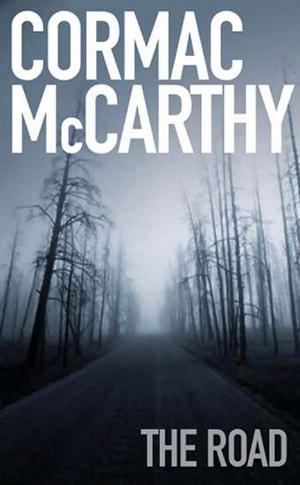
MAJOR BOOK HANGOVER: The Road by Cormac McCarthy. An absolutely stunning achievement. But Christ, it makes most end of the world novels seem like Enid Blyton.
NUMBER OF BOOKCASES YOU OWN: Eight.
ONE BOOK YOU’VE READ MULTIPLE TIMES: The Waste-Land & Other Poems by T.S. Eliot. The language is so breathtakingly poweful and precise, sometimes I just reread the same lines.
PREFERRED PLACE TO READ: Somewhere with a view of the sea.
QUOTE THAT INSPIRES YOU FROM A BOOK YOU’VE READ: I'm not going to pick anything trite and inspirational, I'm just going to pick what I consider to be one of the most perfect openings to a novel ever written. It's inspirational because it's what I'm aiming for, and constantly falling short of:
“My name is Mary Katherine Blackwood. I am eighteen years old, and I live with my sister Constance. I have often thought that with any luck at all, I could have been born a werewolf, because the two middle fingers on both my hands are the same length, but I have had to be content with what I had. I dislike washing myself, and dogs, and noise. I like my sister Constance, and Richard Plantagenet, and Amanita phalloides, the death-cup mushroom. Everyone else in our family is dead.”
We Have Always Lived In The Castle, Shirley Jackson
READING REGRET: That I'll die before I read everything I want to, even if people stopped writing now. And yet, non-reading people get to live on average the same length of time. There's no justice; their years should be mine.
SERIES YOU STARTED AND NEED TO FINISH: The Culture novels by Iain M. Banks.
THREE OF YOUR ALL-TIME FAVOURITE BOOKS: Three? Three? Jesus, it was bad enough picking five for a recent interview. So here's three that I didn't include there:
- The Robber Bride by Margaret Atwood
- House Of Leaves by Mark Z. Danielewski
- The Secret Agent by Joseph Conrad
UNAPOLOGETIC FANGIRL/BOY FOR: Ramsey Campbell. He's the guvnor.
VERY EXCITED ABOUT THIS RELEASE: Too many to mention, obviously, but I'm very much looking forward to The Grieving Stones by Gary McMahon.
WORST BOOKISH HABIT: When I'm reading and someone comes to talk to me and I look like I'm listening to what they're saying, but really I'm still thinking about the book...

X MARKS THE SPOT: START ON THE TOP LEFT OF YOUR SHELF AND PICK THE 27TH BOOK: The Woman In The Dunes by Kōbō Abe.
YOUR LATEST PURCHASE: Bodies Of Water by V.H. Leslie and Oh! The Places You'll Go by Dr. Seuss, for my daughter because it was one of the readings at her Naming Day.
ZZZZ-SNATCHER BOOK (LAST BOOK THAT KEPT YOU UP WAY TOO LATE): Phonogram 3: The Immaterial Girl. I love these graphic novels, in which music really is magic. There's some fantastic use of pop-cultutral imagery and references in this third volume, especially when the protagonist becomes trapped in a murderous version of the video for Take On Me. And the Appendix, explaining all of the musical references is a delight, so I stayed up late reading it and looking up various music videos on the internet.
1/30/2014
Strange Hotels

1/18/2014
The Book That Made Me
Delighted to be taking part in a new special feature on the Ginger Nuts Of Horror site where various authors talk about 'The Book That Made Me'.
I chose the Dark Feasts by Ramsey Campbell, which blew my mind as an impressionable teenager.
You can read what I had to say about it here.
Below is a picture of the Dalek ride that I mention in my piece; you'll have to read it to find out the connection between Daleks and Ramsey Campbell. (It's pretty tenuous to be honest.)
12/12/2013
Best Short Stories of 2013 (Somewhat Biased & Woefully Uncomprehensive)
To be eligible, the stories had to be ones I read for the first time at some point in 2013, and ones that impressed me enough to make a note of them. Then I reviewed the list prior to writing this blog post; any I couldn't really remember and that hadn't stuck with me were discarded.
In general, I've tried to avoid listing any author more than once, but I weakened a few times.
Nina Allen: The Phoeny War (NewCon Press Sampler)
Simon Bestwick: Lex Draconis (Tales Of The Nun & Dragon, Fox Spirit)
Simon Bestwick & Gary McMahon: Thin Men With Yellow Faces (This Is Horror chapbook)
Keith Brooke: Beside The Sea (Memesis, Infinity Plus)
Ramsey Campbell: Holes For Faces (Holes For Faces, Dark Regions Press)
Ramsey Campbell: The Long Way (Holes For Faces, Dark Regions Press)
Mark Chadbourn: Whisper Lane (The British Fantasy Society: A Celebration)
Ted Chiang: Story Of Your Life (Stories Of Your Life And Others)
MR Cosby: Unit 6 (Darker Times)
MR Cosby: In Transit (Darker Times)
Nicole Cushing: The Peculiar Salesgirl (Polluto #10)
Christian A. Dumais: Leave Me The Way I Was Found (Shock Totem #2)
Cate Gardner: Pretty Little Ghouls (Shock Totem #2)
Jessica George: New Town (Impossible Spaces, Hic Dragones)
John Greenwood: Puppyberries (No Monsters Allowed, Dog Horn Publishing)
Shaun Hamilton: The Shuttle (Ill At Ease II, PenMan Press)
Lauren James: Fences (The Side Effects Of The Medication)
Lauren James: The Side Effects Of The Medication (The Side Effects Of The Medication)
Hannah Kate: Great Rates, Central Location (Impossible Spaces, Hic Dragones)
Amelia Mangan: Some Girls Wander By Mistake (No Monsters Allowed, Dog Horn Publishing)
Gary McMahon: Just Another Job (Urban Occult, Anachron Press)
Gary McMahon: The Grotto (NewCon Press Sampler)
Mark Mellon: Asshole Factory (Polluto #10)
Steve Mosby: Fruits (author's website)
Tony Rabig: The Other Iron River (The Other Iron River & Other Stories)
Iain Rowan: The Singing (Supernatural Tales #23)
Christina Scholz: The Lost City Of Emory Winters (The Big Click)
Steve Rasnic Tem: Wheatfield With Crows (Dark World, Tartarus Press)
Lisa Tuttle: Flying To Byzantium (Infinity Plus Quintet)
Stephen Volk: The Arselicker (Anatomy Of Death, Hersham Horror)
Mark West: The Bureau Of Lost Children (Ill At Ease II, PenMan Press)
Leslianne Wilder: Sweepers (Shock Totem #2)
Conrad Williams: The Fox (This Is Horror chapbook)
Jennifer Williams: Spider Daughter Spider (Urban Occult, Anachron Press)
10/07/2013
Guest Post: Hannah Kate & Impossible Spaces
But I'm also a writer myself, and it’s nice to be invited to talk about my own story in the collection, Great Rates, Central Location, which is set in a budget hotel in Manchester. I've written a piece for my own blog about the hotels that gave me the idea for the story, so I thought I’d write something today about the books that I enjoy reading (and which may or may not have inspired my own writing).As well as weird and twist-in-the-tail fiction, I also enjoy fiction that’s more easily described as horror.
Again, I like stories that are grounded in the everyday – but an everyday that’s dark and wrong. It kinda goes without saying that Stephen King is the master of this type of tale. One of my favourite stories by King is his novella The Sun Dog. The story’s opening is so beautifully ordinary – a kid gets a Polaroid camera for his birthday; he’s quite excited about it, and gathers his family together to take his first photo… but as the picture develops in front of his eyes, there’s something wrong with it. It’s the perfect set-up (in my opinion) and the gradual reveal of the ‘wrongness’ is expertly timed.
Finally, there are a couple of up-and-coming horror writers whose work I'm really enjoying at the moment. Simon Bestwick – whose short story ‘Trading Flesh’ can be found in Impossible Spaces – is one of them. Although ‘Trading Flesh’ is a dark, twisted steampunky (in the twisted, post-apocalyptic way) tale, Simon’s novel The Faceless (which I can never recommend highly enough, no matter how hard I try) is grounded in a more ‘real world’ realm of children’s bogeymen, family relations and the historical trauma of war. It’s a truly terrifying read, and Bestwick is brilliant at conjuring up a thoroughly believable world that is riddled with seriously disturbing secrets.
And just in case you thought I was only plugging writers I've had the good fortune to edit… I also want to mention Tom Fletcher. Fletcher’s début horror novel The Leaping is a chilling tale (which gave me actual nightmares). I've seen reviews of this book that have concentrated on the second half of the story, which is set in a bleak Cumbrian landscape redolent with ancient terrors and barely-hidden trauma. But the book actually begins in Manchester, and Fletcher’s descriptions of the unsettling nothingness of city centre living and call centre employment is, perhaps, even more frightening than the rural Gothic of the Lake District. As a Cumbrian-by-birth, adopted Mancunian, The Leaping is, perhaps, closer to my ‘real world’ than any of the other stories I mentioned in this post, and that made me love it even more.
Thank you for indulging this little glimpse into my reading preferences. As I said at the beginning, I don’t know for sure how much any of these books have influenced my own writing… but I know I've had countless hours of enjoyment either way.
9/01/2013
Review: Holes For Faces - Ramsey Campbell
Where to start writing a review of a new collection of Ramsey Campbell short stories? I guess many of you will be familiar enough with Campbell to make it almost seem redundant - most horror fans made up their mind about him years ago, one way or the other. If you admire him as much as I do, all you really need to know is that Holes For Faces collects fourteen recent stories, and that he's as good as he ever was.So there you are: go buy.
Still here? Well okay, let me also add that if by some slim chance you are new to Campbell this is as good an introduction to his late style as any. You'll find all his key traits: the ambiguous imagery, the black humour, the treacherous wordplay. The protagonists of these stories tend to either be children or the elderly - outsiders unable to communicate to their family or colleagues the horrors they see, or think they see. This inability to communicate is key to Campbell's horror - words are as much foe as friend, slippery and keeping people apart rather than drawing them together. Campbell's prose is as sharp and intelligent as ever, as is his ability to conjure up a disturbing image in just a couple of sentences. The characters merely glimpse the phantoms and bogeymen in these stories, rather than seeing them straight on, leaving them (and us) unsure of exactly what they've seen, and how real it was.
Stand-out stories, for me were: Passing through Peacehaven, The Room Beyond, The Rounds (which adds a nice touch of Philip K Dick style uncertainty to Campbell's usual paranoia), the title story, and The Long Way.
6/29/2013
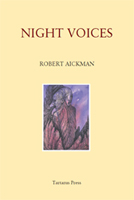
Review: Night Voices - Robert Aickman
I've not reviewed any Robert Aickman books on this blog before, despite how much I admire his writing. The final Tartarus Press reissue of his work is a fine time to rectify that. Night Voices was originally published as a posthumous collection which gathered together Aickman stories not available elsewhere. This lovely Tartarus edition omits The Trains (which they reprinted elsewhere) but adds the novella The Model, a selection of Aickman's non-fiction writing, and Robert Remembered by Ramsey Campbell - a nice tribute.It starts brilliantly - The Stains is a classic Aickman story, with his trademark slow build, exquisite prose, and tantalising symbolism. That sense that more is being implied that is said. It's a showcase of Aickman's ability to delineate a realistic, English setting and characters but yet evoke a faint, surreal sense of disquiet. I don't want to spoil the plot, but I will say the stains themselves are one of Aickman's more hideous little touches.
Just A Song At Twilight is almost as good; a shorter tale with an ending that took me by surprise. I like the fact that Aickman can still surprise me; that I don't yet know all his tricks and techniques. This is the first one I'll reread, seeking out all those tantalising Aickman details...
After that strong start, I have to say the rest of the short stories were definitely second-rate (the presence of The Trains is missed). Aickman, even second-rate Aickman, is always worth reading and his prose is always a pleasure, but I found Laura a somewhat derivative retelling of a common supernatural trope, and I must confess that all I took from a Rosamund's Bower was a sort of pleasurable bafflement. Mark Ingestre: A Customer's Tale is better, another of Aickman's patented 'strange stories' but not quite first-rate, covering themes Aickman did better in his masterly The Swords. Nevertheless it's a suggestive tale and the historical setting is a nice change.
The novella The Model is an interesting read, but nothing like Aickman's other fiction, being a picaresque tale set in pre-revolutionary Russia, about a young girl who wants to be a ballerina. It's not a realistic piece, having a dream-like, fairytale atmosphere. It was a lovely journey, but I can't say I felt I actually arrived anywhere.
The non-fiction section of the book largely consists of Aickman's series of introductions to the Fontana Book Of Great Ghost Stories series, which he edited. Taken together, they form a virtual manifesto of the ghost story, which Aickman is at great pains to distinguish from the horror story. Although I disagree with a lot of what he says, the manifestos of geniuses are always fascinating. Suggestive ideas abound; I will quote just one:
"I should like to suggest that the now the word 'ghost' should be seen more as the German geist: that ghost stories should be concerned not with appearance and consistency, but with the spirit behind the appearance..."
These essays are full of such gems, and any writers of horror (sorry, Robert!) are certain to find much to think over, much inspiration.
Overall, this book is like one of those rarities albums bands release when they're no longer together - interesting to the fans and obsessives, but hardly the best place to start for someone new. Night Voices contains much of Aickman's brilliance but, for this reader, some misfires and duds as well . If you're new to Aickman, start with Cold Hand In Mine or Dark Entries. But if you're already under his spell, you'll find nothing in this volume to break that spell; Aickman was one of the best there's ever been, it's simple as that.
2/19/2013
Review: The Overnight by Ramsey Campbell
Ramsey Campbell is an author seemingly as prolific as he is influential – I'm a big fan, but I've still got a number of his books to read. Fortunately my wife got me four of his books newly reissued as paperbacks from PS Publishing for Christmas. The first I've read is The Overnight.12/02/2012
Review: Just Behind You - Ramsey Campbell
It's hard to know quite where to start reviewing a new collection of Campbell's short fiction (I say new - this came out in 2009). I must have read over a hundred of his stories by now and for a writer with such a distinctive style as Campbell's, that's bound to led to some slight diminishing returns, no matter the quality of the stories.I suppose I started thinking along these lines because the first two stories in the book were somewhat disappointing; Fear The Dead being a second-rate rehash of previous Campbell ideas, and Digging Deep seeming to exist only as a means to getting to its weak punchline.
But then, just as the doubts were starting to set in, Campbell follows with two excellent tales - Double Room, a disturbing story of a man alone in a hotel room at night who starts hearing voices (I was initially worried it was going the same way my own The Other Room...). And then The Place Of Revelation which is even better, a homage to Machen's The White People (I think) - something genuinely new and intriguing in Campbell's fiction and one for any future 'best of'.
So the score at this point, two all.
Fortunately, most of the rest of the stories in the collection were better than the first two, with only a few others I didn't particularly care for. (I should say, even the weaker tales in the book are still well-written and interesting, second-rate Campbell still being better than a lot of writer's best work.) Amongst the most compelling were Unblinking, a disturbing story about an academic's jealous descent into madness; The Unbeheld; and the Lovecraft influenced Raised By The Moon.
My favourite story of all was the titular one, a typical Campbell master-class in making the mundane creepy. This is the kind of thing he does so well, something I'm sure most readers of this blog don't need to be told.
So despite some initial misgivings, Campbell's place in my own personal 'Top Five Horror Short Story Writers' chart has been retained. Just Behind You has just been re-released in paperback from PS Publishing (although I bought a snazzy signed copy of the limited hardback) and Campbell fans would be well advised to pick up a copy, along with the other new PS paperbacks.
11/26/2012
Review: Black Flowers by Steve Mosby
I don’t read tons of crime fiction – I'm a dabbler. But Steve Mosby's name has been floating around the part of my mind devoted to the ever-present ‘what book to read next?’ question for some time, partly because of his excellent short stories in both Off The Record 1 & 2, and partly from seeing a recommendation for his book Black Flowers from Ramsey Campbell.